Dual 4:1 analog mux with -90 dB crosstalk
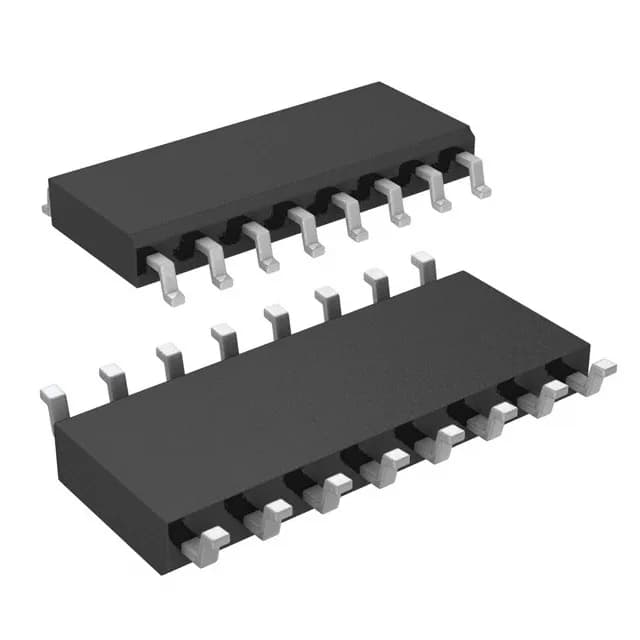
The MAX4052AESE+ from Maxim Integrated packs two independent SP4T (single-pole, four-throw) analog switches into a 16-SOIC, giving you a 4:1 multiplexer/demultiplexer per channel. Each switch connects a common pin to one of four outputs (or the reverse), with a break-before-make action that prevents momentary shorting between channels. The headline spec here is the -90 dB crosstalk at 100 kHz — that's the isolation you get between active channels when switching audio, low-frequency instrumentation signals, or precision analog voltages. For a dual mux in this package, that figure tells you the part was laid out for signal integrity, not just density.
Supply flexibility for mixed-voltage boards
This part runs on either a single supply from 2 V to 16 V or a dual supply from ±2.7 V to ±8 V. That ±5 V rail common in analog front-ends is right in the sweet spot. The 100 Ω max on-resistance is moderate — fine for routing signals into a high-impedance ADC input or an op-amp buffer, but you'll want to check the voltage drop if you're switching a current-loop signal. Channel-to-channel matching is 6 Ω max, so gain errors from mux resistance stay consistent across all four positions in a given bank.
175 ns switching — fast enough for most acquisition windows
Max turn-on time is 175 ns, turn-off 150 ns. That's fast enough to sequence through four channels in under a microsecond, which suits a 250 kSPS SAR ADC's track-and-hold window. If you're pushing into the MHz range or building a high-speed crosspoint, you'll want a faster CMOS switch — but for general-purpose data acquisition, audio routing, or ATE pin electronics, this timing keeps the bus clear.
Precision metrics: charge injection and leakage
Charge injection is spec'd at 2 pC — that's the glitch the switch dumps onto the analog bus when it turns off. In a sample-and-hold or a precision integrator, that 2 pC translates to a voltage step across the hold capacitor; you'll budget for it in the acquisition settling time. Off-leakage is 100 pA max, and channel capacitance is 2 pF on both the source and drain sides. Combined, these keep the signal path clean when the mux is idle and don't load down a high-impedance source.
Temperature range and package
Rated for -40°C to +85°C ambient, this is an industrial-temperature part — fine for factory-floor instrumentation, outdoor telecom cabinets, and engine-bay-adjacent electronics that don't see continuous under-hood heat. The 16-SOIC (0.154" body width, 3.90 mm) is a common footprint, easy to route on a two-layer board. The "+" suffix in the order code indicates lead-free and ROHS3 compliant, so it passes the usual environmental directives without a waiver.
Lifecycle and sourcing note
Maxim lists the MAX4052AESE+ as Active — no last-time-buy notice, no NRND flag. That means you can qualify it into a new BOM without worrying about an imminent end-of-life redesign. If you're dual-sourcing, the ADG409 is a commonly cross-shopped 4:1 dual mux in the same 16-SOIC footprint — check the pinout and supply range against your layout before substituting.