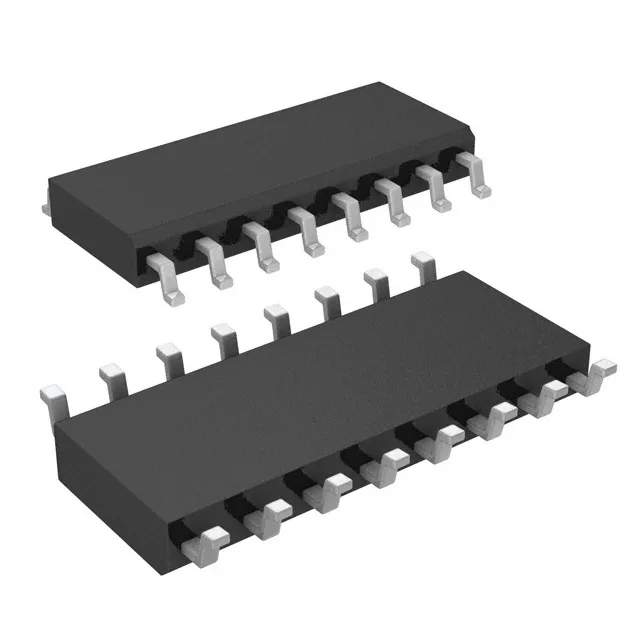
8:1 multiplexer with 100 Ohm on-resistance
The MAX4051ESE+ is an 8:1 single-ended multiplexer/demultiplexer from Analog Devices, housed in a 16-SOIC surface-mount package. It routes one of eight analog or digital inputs to a common output with a maximum on-state resistance of 100 Ohms. The 100 Ohm Ron is specified at the supply voltage — the actual resistance drops as the supply rises toward the 16 V single-supply ceiling. For precision applications, the channel-to-channel matching of 12 Ohms max keeps the gain error consistent across all eight paths.
Signal integrity: crosstalk and charge injection
Crosstalk is rated at -90 dB at 100 kHz, meaning a 1 Vpp signal on one channel couples less than 32 µV into an adjacent off channel at that frequency. This suits multiplexing low-level analog signals — thermocouple or strain-gauge outputs — where even microvolt bleed corrupts the reading. Charge injection is 2 pC typical. When the switch opens, that 2 pC of charge dumps onto the sampling capacitor of a downstream ADC — for a 10 nF hold cap the voltage step is 200 µV. The 2 pF off-channel capacitance (CS(off), CD(off)) adds to the node capacitance and sets the settling time budget. Switching times are 175 ns turn-on and 150 ns turn-off maximum — fast enough to scan eight channels at 500 kHz without missing a sample window. The 1 nA max off-leakage means the held voltage on a 10 nF cap drifts less than 1 mV over a 10 ms scan interval.
Single-supply operation spans 2 V to 16 V; dual supplies run from ±2.7 V to ±8 V. The signal swing tracks the supply: with V+ = 5 V and V- = 0 V, the analog input range is 0 V to 5 V. No derating curve is published, but the 100 Ohm Ron and 1 nA leakage are specified across the full temperature band.
It is ROHS3 compliant — no exemptions for lead in solder or other restricted substances. The tube delivery is the factory-standard for this SOIC-16 variant; reel options exist for the same die in a different order code.