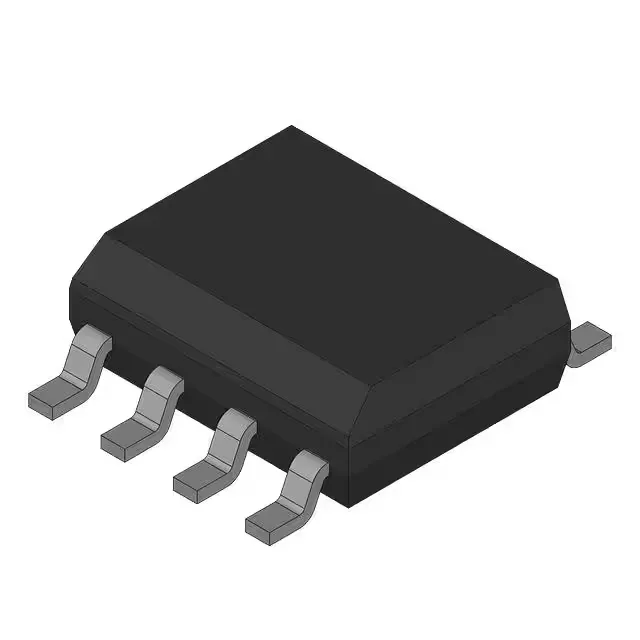
The MAX404ESA: It's a micropower part — each channel draws 14 µA of supply current — so it's aimed at battery-powered sensor conditioning, portable instrumentation, and low-frequency signal chains where every microamp counts. The 90 kHz gain-bandwidth product and 0.04 V/µs slew rate tell you this isn't for audio or fast control loops; it's for DC-accurate amplification, filtering below a few kilohertz, and level-shifting tasks where the load current stays under 2.5 mA per channel.
The supply span runs from 2.4 V minimum to 5.5 V maximum. No split supplies needed.
Rail-to-rail output and input offset — the practical limits
The output swings rail-to-rail. The input offset voltage is 200 µV typical. Input bias current is 2 nA typical.
It's listed as RoHS non-compliant, which means it uses lead-bearing solder terminations — a consideration if your assembly line is restricted to RoHS-only materials, though many industrial and MRO applications still accept the exemption.