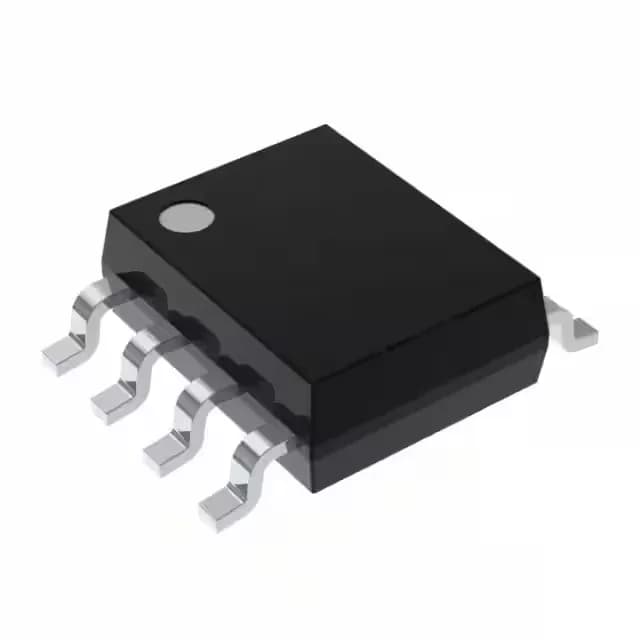
The MAX4041ESA+: It draws just 14 µA of supply current while delivering a 90 kHz gain-bandwidth product and a 0.04 V/µs slew rate — a combination that puts this part squarely in the micropower signal-conditioning class, not the high-speed or audio tier. The rail-to-rail output stage lets the signal swing to both supply rails, which matters when the supply is as low as 2.4 V and every millivolt of headroom counts. Typical applications include battery-powered sensor amplifiers, portable instrumentation, and low-frequency active filters where the priority is extending battery life, not chasing bandwidth.
The 14 µA supply current is the spec that defines this part. In a multi-channel design running from a coin cell or a small Li-Po, every op-amp that draws a few hundred microamps instead of a few milliamps saves real battery life. The trade-off is the 90 kHz gain-bandwidth — at a gain of 10, the usable signal bandwidth drops to about 9 kHz, so this is a DC-to-low-frequency part. The 200 µV input offset voltage is typical for a general-purpose op-amp at this power level; if you need sub-50 µV offset, you step up to a zero-drift amplifier and pay more current. The 2 nA input bias current is low enough for most resistive sensor interfaces, though photodiode transimpedance stages with high feedback resistors may want a FET-input part instead.
The part is not qualified to AEC-Q100, so it is not the first choice for under-hood automotive, but it will handle a factory floor or a telecom cabinet.
Package and footprint notes
The supplier device package is 8-SOIC, and the part ships in Tube. No thermal pad or exposed paddle — the junction-to-ambient thermal path is through the leads and the PCB copper. For a 14 µA part, self-heating is negligible, so no special layout is needed beyond normal decoupling.