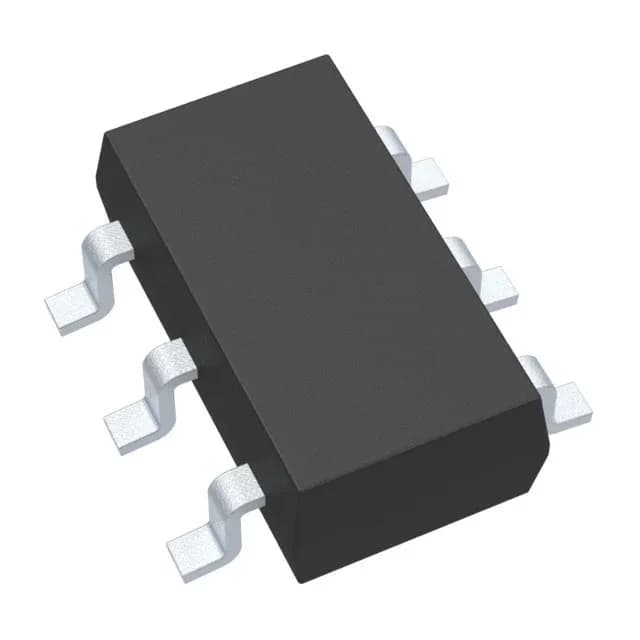
Current-sense amplifier for precision shunt monitoring
The MAX40010FAUT+T is a single-channel current-sense amplifier from Analog Devices designed to measure current by amplifying the voltage drop across an external shunt resistor. It delivers an 80 kHz bandwidth with a low input offset voltage of 12 µV, enabling accurate sensing of small differential signals. The supply range spans 2.7 V to 5.5 V, suiting it for 3.3 V and 5 V rails as well as single-cell Li-ion applications. Quiescent current is 350 µA, making it viable for always-on monitoring in battery-powered systems. The part is housed in a SOT-23-6 package with surface-mount mounting, and operates over -40°C to 125°C, covering industrial and automotive under-hood temperature ranges.
80 kHz bandwidth — what it means for the measurement
The 80 kHz -3 dB bandwidth sets the upper frequency limit for current transients the amplifier can faithfully reproduce. For DC load monitoring or low-frequency PWM sensing (e.g., motor current at a few kHz), this is more than adequate. If the application requires capturing switching edges from a 100 kHz+ power converter, the bandwidth will roll off the signal — plan for a wider-bandwidth part or accept the attenuation.
12 µV offset and 65 µA input bias — accuracy budget
With a 12 µV input offset voltage, the error contribution from offset is small relative to a typical 50 mV full-scale shunt drop — roughly 0.024% of reading. The 65 µA input bias current flows through the shunt and adds a voltage error proportional to the shunt resistance. For a 10 mΩ shunt, that is 0.65 µV — negligible. For a 1 Ω shunt, it becomes 65 µV, which may dominate the offset budget. Keep the shunt resistance low enough that the bias-current drop stays below the acceptable error floor.
Lifecycle and sourcing
The MAX40010FAUT+T carries an Active product status and is ROHS3 compliant.