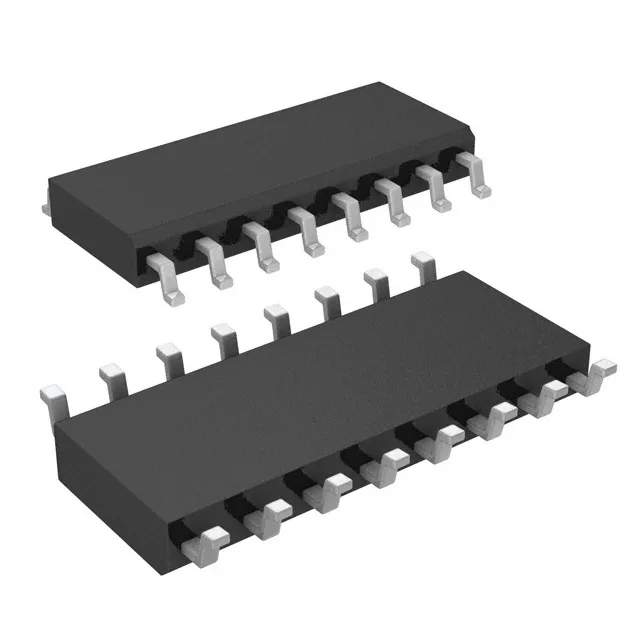
The MAX398ESE+ is a single 8:1 CMOS analog multiplexer in a 16-SOIC package. The 100 Ohm max on-resistance sets the voltage drop across the switch at a given signal current — for a 10 mA signal, that is a 1 V drop, so budget the headroom in the downstream stage. The 6 Ohm max channel-to-channel matching means the Ron variation between any two channels is tight enough that gain errors from the mux itself stay below 0.6% in a unity-gain buffer configuration. Switching time is 150 ns typ for both turn-on and turn-off. That sets the minimum channel update period at about 300 ns for a clean break-before-make transition — useful for multiplexing a single ADC across eight sensor inputs at sample rates up to roughly 3 MSPS per channel, assuming the ADC acquisition time dominates. Crosstalk is -92 dB at 100 kHz. For a 10 Vpp signal on one channel, the coupled feedthrough onto an off channel is about 2.5 µV — negligible for 12-bit systems but worth noting if you are multiplexing a 24-bit sigma-delta ADC where the noise floor sits below 1 µV.
Supply flexibility and charge injection
Single-supply operation from 3 V to 15 V or dual supplies from ±3 V to ±8 V — the part handles ground-referenced bipolar signals when run from split rails. The 2 pC typical charge injection is the amount of charge dumped onto the signal line when the switch turns off; into a 100 pF sampling capacitor that is a 20 mV glitch, so a sample-and-hold ahead of the ADC should acquire after the switch settles. Leakage current is 100 pA max off-channel, and off-channel capacitance is 40 pF. At 100 kHz, the 40 pF capacitance gives about 40 kOhm impedance to ground — fine for low-impedance sources but a concern if the source impedance is above 10 kOhm, where the capacitive divider starts attenuating the signal.