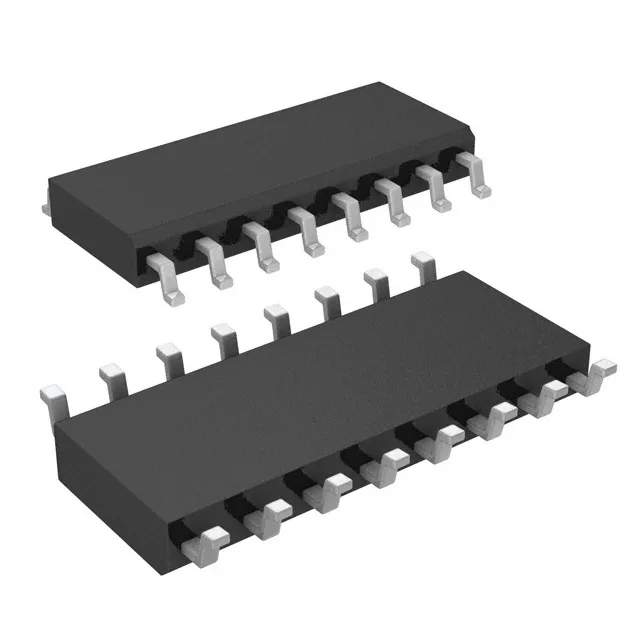
Dual SPDT switch for precision analog signal routing
The MAX383ESE+: Each switch independently connects a common terminal to one of two outputs (2:1 multiplexer/demultiplexer topology), giving you two independent single-pole double-throw channels on one IC.
35 Ohm on-resistance and -90 dB crosstalk at 1 MHz
The 35 Ohm max on-resistance is low enough to pass audio and low-frequency analog signals with minimal attenuation when the load impedance is high (e.g., 10 kOhm or greater), but the 500 mOhm channel-to-channel matching matters more for differential or stereo paths where gain mismatch between channels creates crosstalk or offset. The -90 dB crosstalk at 1 MHz means the off-channel isolation is excellent through the audio band and into the low-MHz range — a 1 Vpp signal on one channel couples less than 32 µV into the other at 1 MHz, which keeps adjacent channels from bleeding into each other in multiplexed ADC front-ends or audio crosspoint switches. Charge injection is 2 pC typical — when the switch opens, that small packet of charge dumps onto the sampling capacitor in a track-and-hold or into the feedback node of an op-amp. For a 10 nF hold capacitor, 2 pC creates a 200 µV step; for a 100 pF cap, the step is 20 mV. The 12 pF off-capacitance on both source and drain adds to the node capacitance and sets the bandwidth limit when the switch is off — at 1 MHz, 12 pF presents about 13 kOhm of reactance, which is still high enough to keep the off-isolation above -90 dB as specified.
Supply flexibility and switching speed
The MAX383ESE+ runs from a single supply of 3 V to 15 V or dual supplies of ±3 V to ±8 V. With dual supplies, the analog signal can swing symmetrically around ground — useful for bipolar signals in audio or industrial analog I/O. The max turn-on time is 175 ns and turn-off is 100 ns, which sets the channel-switching rate ceiling: at 175 ns, the switch can change state at about 5.7 MHz before the timing eats into the valid-data window. The 200 pA max off-leakage keeps the off-channel from loading the signal bus — at 85°C, leakage rises but stays in the pA range, preserving accuracy in high-impedance sensor interfaces.
Industrial temperature range and package
Surface-mount assembly with the tube packaging means the parts ship in anti-static tubes for manual or low-volume pick-and-place.