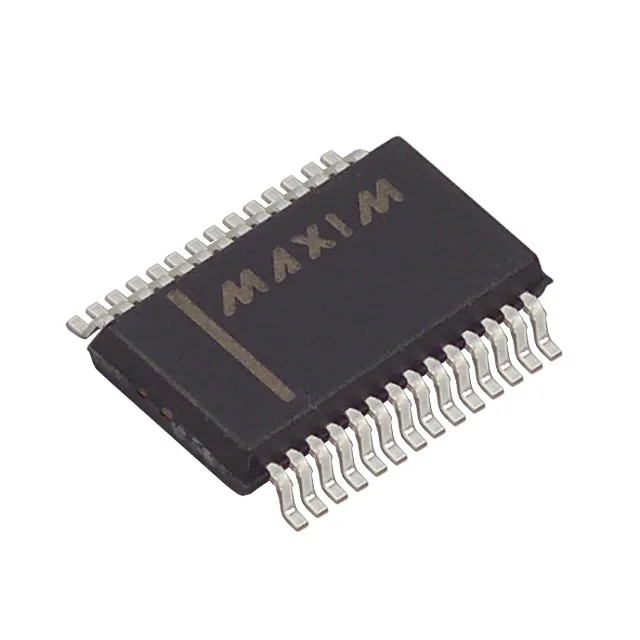
16:1 analog multiplexer in 28-SSOP
The MAX336EAI+T is a single 16:1 analog multiplexer from Analog Devices, designed to route one of sixteen analog inputs to a common output. It is built for precision signal switching in data-acquisition, test, and instrumentation chains where channel count and signal fidelity matter. The on-state resistance is 400 Ohm max, with channel-to-channel matching of 5 Ohm — the matching figure matters more than the absolute R_on in a ratiometric measurement system, because the voltage drop across each channel stays consistent channel to channel. Crosstalk is rated at -86 dB at 100 kHz, meaning a signal on one channel couples into the off-channels at a level roughly 20,000 times below the carrier — sufficient for 16-bit systems scanning at moderate rates without guard traces between channels.
Supply flexibility and signal integrity
Dual-supply operation lets the switch pass bipolar signals without a DC bias — the signal swing is limited only by the rail voltages, not a virtual ground. Charge injection is 3.5 pC typical. In a sample-and-hold front end, this injected charge appears as a voltage step across the hold capacitor — for a 10 nF cap, the step is 350 µV, which sets the floor for the acquisition's settling accuracy. Switching times are 500 ns max for both turn-on and turn-off. The symmetrical speed means the multiplexer can be used in break-before-make scanning without dead-time compensation in the firmware. Off-channel leakage is 20 pA max, and off-channel capacitance is 2 pF on the source side, 20 pF on the drain side. The low leakage keeps the DC error below 1 µV into a 50 kOhm load, while the capacitance limits the off-channel isolation at higher frequencies — expect isolation to degrade above 1 MHz as the capacitive feedthrough dominates.
Package, temperature, and compliance
Housed in a 28-SSOP (0.209-inch, 5.30 mm width) surface-mount package, with the supplier device package also listed as 28-SSOP. The 0.025-inch lead pitch demands a standard SSOP footprint — no fine-pitch soldering challenge, but the narrow body means the thermal pad is absent; heat is conducted through the leads only. The part is rated for the full range, not just typical — the leakage and R_on specs are guaranteed across the temperature band, not just at 25°C. Packaging options include Tape & Reel (TR) and Cut Tape (CT). The T suffix in the order code indicates the tape-and-reel format, which is the standard for automated pick-and-place assembly.