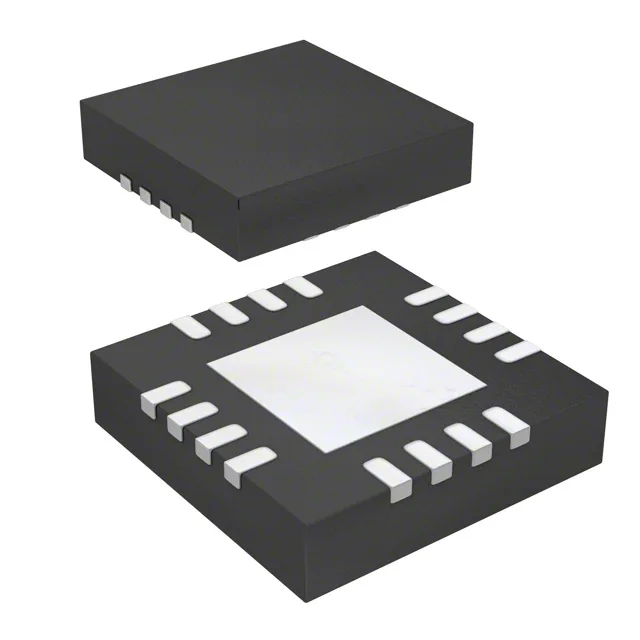
8:1 analog multiplexer for precision signal routing
The MAX328ETE+T is an 8:1 single-ended analog multiplexer from Analog Devices, designed to route one of eight input signals to a common output. Its 3.5kOhm on-state resistance is relatively high compared to modern CMOS switches, but the part's strength lies in its ultra-low leakage and charge injection specs — 10pA max off-leakage and 2pC charge injection — making it suitable for high-impedance sensor interfaces and sample-and-hold front ends where every picoamp of error matters. The supply flexibility is a key differentiator: it operates from a single 10V to 30V rail or from dual ±5V to ±18V supplies. This means the same part can handle a ±15V industrial analog signal chain or a single-supply 12V data acquisition system without a level shift.
Signal integrity specs that matter for analog front ends
Channel-to-channel on-resistance matching is 70Ohm max, which matters when the mux is used in a gain-setting or feedback network where R-on variation creates offset errors. The switch timing — 1.5µs turn-on, 1µs turn-off max — limits the multiplexer to low-frequency scanning; it won't keep up with a 100kHz sampled system, but for a multi-channel thermocouple or RTD front end scanning at a few hundred hertz it is more than adequate. Channel capacitance is 1.8pF off (source side) and 8pF off (drain side). The 8pF CD(off) loads the output bus when multiple channels are tied together; in a daisy-chained multiplexer bank this capacitance sums and can slow the settling time. The 2pC charge injection is the charge dumped onto the signal path when the switch turns off — for a 10pF hold capacitor this translates to a 200µV step, which is acceptable for 12-bit systems but needs consideration at 16-bit resolution.