Dual SPST-NO analog switch — what the key ratings mean for your signal path
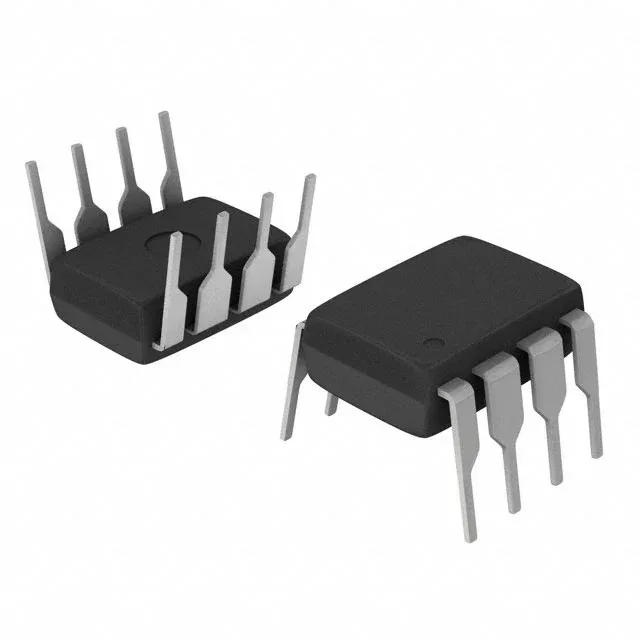
The MAX320CPA+ is a dual SPST-NO (single-pole, single-throw, normally-open) analog switch from Analog Devices, packaged in an 8-pin DIP (0.300", 7.62mm) with through-hole mounting. Each switch conducts equally well in both directions, making it suitable for routing audio, low-frequency analog signals, or digital control lines up to the supply rails. Its 35 Ohm maximum on-resistance (Ron) is moderate — fine for low-impedance loads where the voltage drop across the switch is small, but not for precision high-impedance sensor front-ends where the Ron variation with signal voltage would introduce gain error. The channel-to-channel matching of 300 mOhm (ΔRon) means the two switches track closely, which matters in differential or stereo audio paths where left-right imbalance would be audible. Switching is fast: 150 ns turn-on and 100 ns turn-off (max). This is fast enough for audio muting, gain switching, or multiplexing signals in the low-MHz range. The 2 pC charge injection is the amount of charge dumped onto the signal line when the switch turns off — low enough that in a 10 kΩ load it creates a glitch of roughly 20 µV, negligible for most audio and instrumentation circuits. Crosstalk between channels is -85 dB at 1 MHz — that is good isolation for a dual switch in a DIP package. It means a signal on one channel leaks less than 0.006% into the other at 1 MHz, so the two switches can handle independent signals without noticeable bleed-through.
Supply voltage range and operating conditions
The MAX320CPA+ runs from dual supplies of ±2.7 V to ±8 V. Off-state leakage current is a maximum of 100 pA per switch, and off-state capacitance is 9 pF per channel. The low leakage means the switch does not load the signal source when it is supposed to be open, preserving accuracy in sample-and-hold or high-impedance multiplexing applications.
Lifecycle, compliance, and sourcing
It is available through independent distribution channels; sourcing is confirmed against an RFQ for the required quantity.