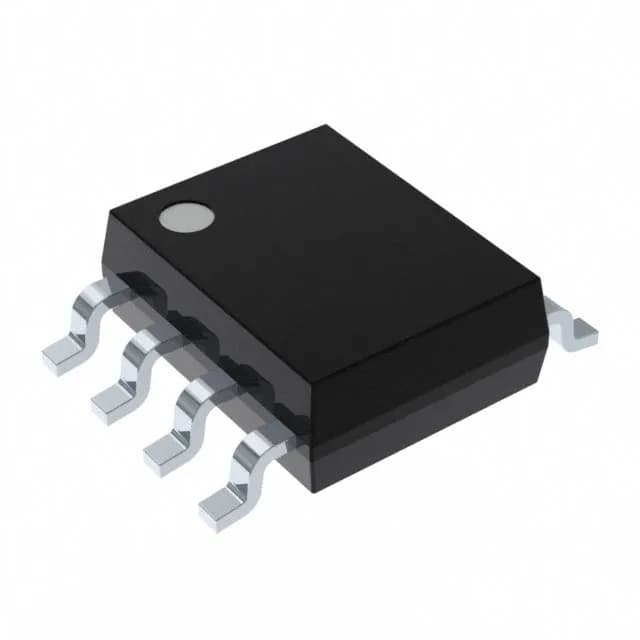
Thermocouple front-end in a single SOIC
It handles the cold-junction compensation on-chip and linearises the thermocouple curve, so the host microcontroller doesn't need lookup tables or analogue front-end circuitry. This is the part a design engineer reaches for when they need a clean digital temperature measurement from a thermocouple without building a precision amplifier and reference — just a single 8-SOIC part and a few passive components.
900 µA supply — what it means for system power
The supply current is rated at 900 µA. For a battery-powered data logger or a wireless temperature node, this quiescent draw is low enough that the converter can be left running continuously without dominating the power budget. In a 3.3 V system, that's roughly 3 mW — well within the margin for a sensor that's always on. If the host MCU can gate the supply via a GPIO-driven load switch, the converter's own shutdown current is even lower, but the datasheet typical active number already fits most portable applications without duty-cycling.
Temperature range and deployment context
That's the full industrial and automotive under-hood range. The thermocouple itself can measure far beyond those limits (a K-type goes to 1372°C), but the converter's own silicon and cold-junction sensor are rated for the ambient temperature around the PCB. This part is at home in engine compartments, industrial ovens, HVAC ductwork, and outdoor telecom enclosures where the electronics see 85°C+ ambient.
Lifecycle and sourcing reality
No last-time-buy pressure, no forced redesign.