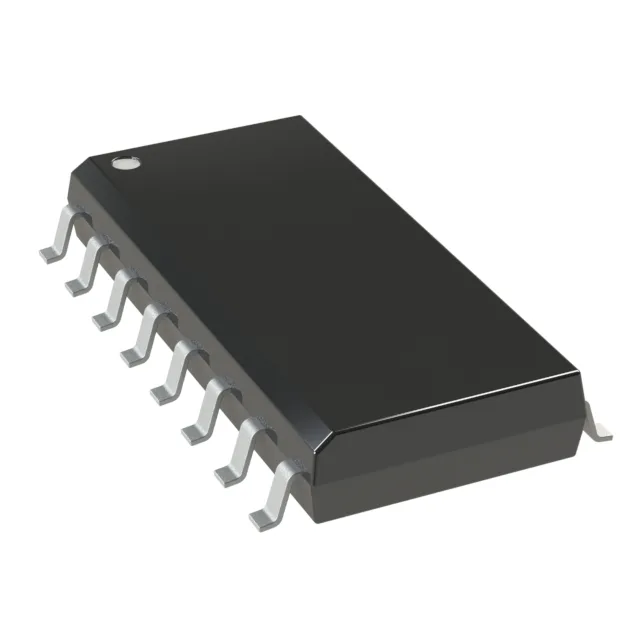
Package and rework reality — 16-TSSOP on the bench
The MAX313EUE+T comes in a 16-TSSOP (0.173", 4.40 mm width) — a fine-pitch SSOP derivative with 0.65 mm lead spacing. The body is small enough that a standard hot-air nozzle covers all eight leads on one side in a single pass, so hand rework is practical if the board-side thermal relief on the ground paddle is kept to a minimum. Surface-mount only — no through-hole variant exists. The 16-TSSOP footprint matches the JEDEC MO-153 standard, so the land pattern is well-documented in any PCB layout tool's library.
On-resistance and what it means for signal headroom
10 Ohm max on-state resistance (Rds(on)) — at a 10 mA signal current the drop is 100 mV; at 100 mA it is 1 V. In a ±15 V dual-supply system that 1 V eats into the output swing, so the downstream stage's common-mode rejection needs to account for it. The 300 mOhm channel-to-channel matching (ΔRon) keeps the gain error consistent across all four switches, which matters for a precision multiplexer front-end.
Switching speed and crosstalk — where the limits sit
Turn-on time is 225 ns max, turn-off is 185 ns max — fast enough for audio-band multiplexing (up to ~2 MHz switching rate) but not for video-rate crosspoint applications where sub-50 ns switching is needed. The charge injection is 20 pC, which translates to a voltage glitch on the output capacitance; at a 15 pF load that is about 1.3 mV of feedthrough per switch event. Crosstalk is -85 dB at 1 MHz — this is the isolation between channels at a typical audio or low-frequency switching rate. It means less than 0.006% of the signal on one channel bleeds into the adjacent one at 1 MHz, which is clean enough for 16-bit audio paths but marginal for 24-bit systems where the noise floor is below -100 dB.
Leakage and capacitance — the static and dynamic load
Max off-leakage current is 500 pA — negligible for most signal paths, but in a high-impedance sensor front-end (10 MOhm source impedance) it contributes a 5 µV offset error at 25°C. The leakage doubles roughly every 10°C, so at 85°C it is about 8 nA, which starts to matter for a 10-bit ADC reading a 100 kOhm bridge. Channel capacitance is 15 pF on both the source and drain sides — this sets the bandwidth roll-off with the source impedance. Into a 10 kOhm source the -3 dB point is about 1 MHz, well above the audio band.
This covers factory-floor control cabinets, outdoor telecom shelters, and under-hood automotive-adjacent electronics that see moderate heat but not the full 125°C engine-bay soak.