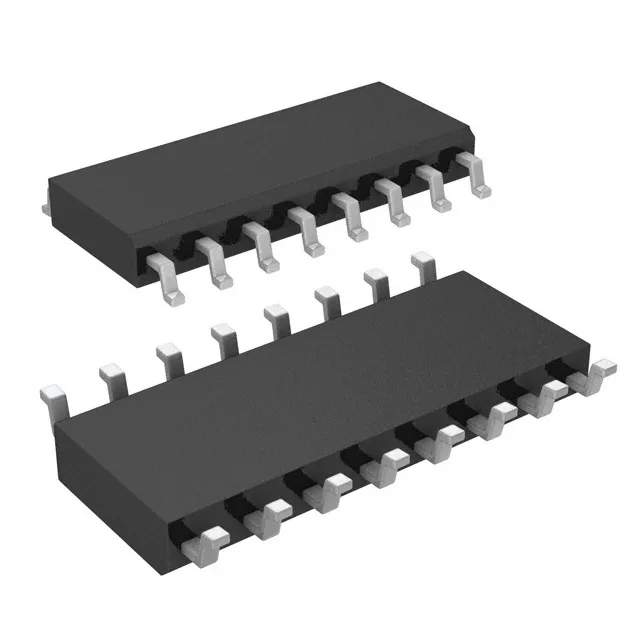
Active quad RS-422/RS-485 receiver — BOM-fit for 5 V industrial buses
The MAX3093EESE+T: Its 45 mV of receiver hysteresis filters out noise on long differential bus runs — the hysteresis band sits above the typical common-mode noise floor on a factory-floor twisted pair, so the output does not chatter on a floating bus. Four receivers in a single 16-SOIC package means one IC handles a full duplex RS-422 link (two differential pairs) or a multi-drop RS-485 node with the transmitter elsewhere.
Supply rail and noise margin — what the 5 V ±5 % and 45 mV hysteresis mean on the bench
A 5 V rail that droops below 4.75 V during a brownout or a hot-swap event will drop the receiver out of specification — the input common-mode range and the differential threshold accuracy are only guaranteed inside this supply band. Budget a local 5 V LDO or a bulk cap that holds the rail above 4.75 V during the worst-case transient. Receiver hysteresis of 45 mV sets the minimum differential input voltage needed to guarantee a valid logic state after the input crosses the threshold. On a long RS-485 stub with 200 mV of ground-shift noise, the 45 mV hysteresis prevents the output from toggling on each noise spike — the receiver only switches when the differential signal exceeds the hysteresis band plus the threshold offset. At 10 Mbps the bit period is 100 ns. The receiver propagation delay and the cable's signal rise time must sum to less than the bit period for the bus to close timing. This part is sized for short-haul factory-floor links up to a few hundred metres at full speed; longer runs trade data rate for cable length per the RS-485 cable-length vs data-rate curve.
Package and reel format — what ships on the tape
The narrow SOIC footprint matches the industry-standard 16-pin SOIC land pattern — no board spin needed if the existing layout already uses a 16-SOIC wide-body or narrow-body receiver. RoHS3 compliant per the lifecycle entry — no exemption-listed substances above the threshold.
Sourcing posture — active part, quoted to order
No pin-compatible second source or official successor is listed on the ledger. If a dual-source hedge is needed, the functional replacement is a different order code with the same 16-SOIC footprint and RS-422/RS-485 protocol — confirm the pinout and hysteresis spec before substituting.