Active production — what that means for a BOM line
The MAX3087CSA+: RoHS3 compliance is confirmed, which covers the full substance restriction list including the six original RoHS substances plus four phthalates — no exemption paperwork needed for EU or UKCA markets.
10 Mbps full-duplex — the data-rate ceiling and what limits it
Rated for 10 Mbps in full-duplex mode, the MAX3087CSA+ handles one driver and one receiver simultaneously on a single twisted pair per direction. The 10 Mbps ceiling is the maximum toggle rate the driver can sustain into a 54-Ω terminated bus — above that the output slew rate cannot maintain valid differential levels across the cable's RC roll-off. The 100 mV receiver hysteresis provides 50 mV of noise margin on each side of the differential threshold. On a long cable run with common-mode noise from adjacent VFDs or switching supplies, that margin prevents the receiver from chattering on the zero-crossing — a 50 mV hysteresis part would false-trigger in the same environment.
Supply rail and temperature — the operating envelope
If the system uses a 5 V rail that dips below 4.75 V during brownout or startup sequencing, the transceiver's output differential voltage drops below the 1.5 V minimum the RS-485 spec requires at the far end. This suits indoor equipment, telecom racks, and lab instrumentation but not outdoor enclosures, engine bays, or cold-chain logistics — those need the industrial or automotive grade variant.
Package and board-fit — 8-SOIC footprint
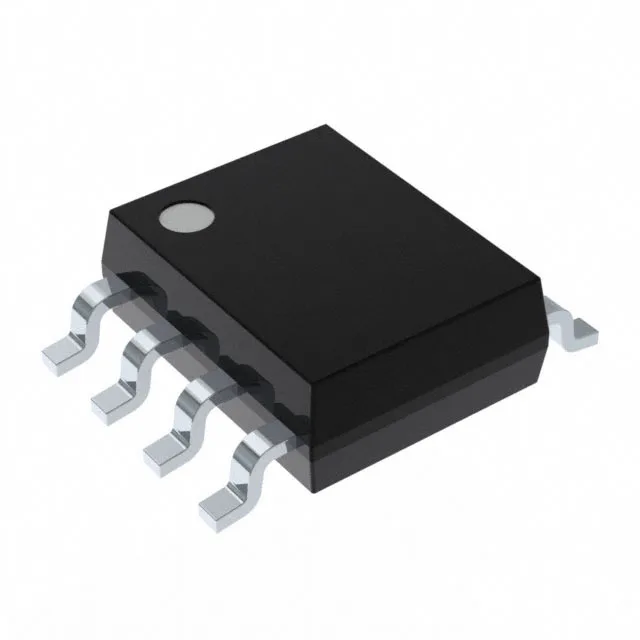
Supplied in an 8-SOIC package — 0.154-inch body width, 3.90 mm, the standard narrow SOIC footprint that matches thousands of existing PCB layouts. Surface-mount assembly with no exposed pad; the thermal path is through the leads alone, so ambient temperature derating follows the JEDEC 2s2p board profile. Shipped in tube — not tape-and-reel. For pick-and-place volume, confirm the tube-to-reel transfer with your assembler or order the tape-and-reel suffix variant if one exists in the family.