What the 16:1 topology and 100 Ohm on-resistance mean for your signal chain
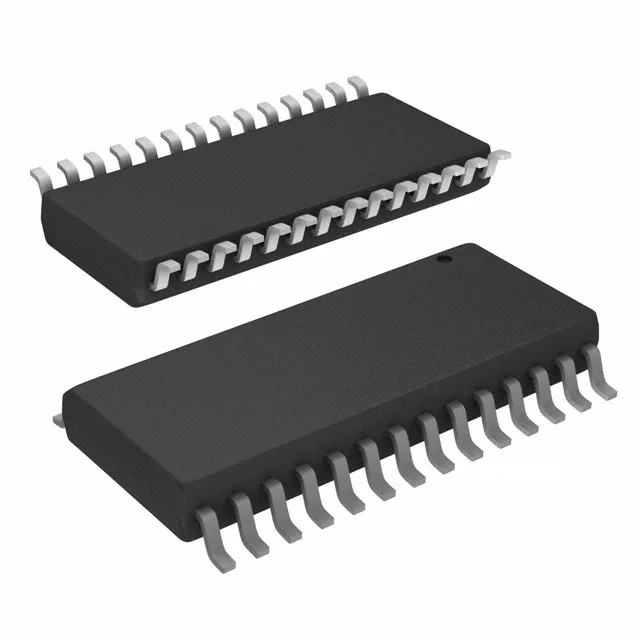
The MAX306EWI+ is a single 16-channel analog multiplexer in a 28-SOIC package — one 16:1 mux that routes one of sixteen analog inputs to a common output, or conversely demultiplexes a single input to sixteen outputs. The 100 Ohm max on-resistance is typical for a CMOS mux of this channel count; the channel-to-channel matching of 1.5 Ohm means the insertion loss variation across channels stays tight, which matters when you are scanning multiple sensor signals through the same gain stage. Switching time is 200 ns on, 150 ns off — fast enough for audio-rate multiplexing or moderate-speed data acquisition, but not for video or high-frequency RF switching. The -92 dB crosstalk at 100 kHz tells you that a signal on one channel couples negligibly into another, a key spec when you are multiplexing low-level analog signals in a mixed-signal system.
Supply rails, charge injection, and leakage — the analog designer's checklist
The part runs from a single supply of 5 V to 30 V or dual supplies of ±4.5 V to ±20 V. That dual-supply capability lets it pass bipolar signals without level-shifting — a common requirement in industrial analog front-ends where the signal swings below ground. Charge injection is 2 pC typical; at that level, the voltage glitch seen at the output depends on the load capacitance — with a 10 pF sample-and-hold cap, the injected charge produces a 200 mV step that settles within the switch's turn-off time. Off-channel leakage is 500 pA max — negligible for most applications, but worth checking if the source impedance is in the megaohm range, where the leakage current multiplied by the source resistance produces an offset voltage that could exceed the system's error budget. The off capacitance on the drain side is 130 pF, which will limit the bandwidth when the mux is driving a high-impedance load; expect a -3 dB point around 12 MHz into a 100 kOhm load.