Filter topology and what the 50 kHz cutoff means for your signal chain
The MAX295EPA+ is an 8th-order Butterworth low-pass switched-capacitor filter, with a cutoff frequency of 50 kHz. The Butterworth response gives maximally flat passband gain — no ripple to amplify out-of-band noise, but the roll-off is gradual compared to an elliptic or Chebyshev, so the stopband rejection at, say, 60 kHz is around 48 dB, not the 80+ dB a sharper filter would deliver. That matters when you need to band-limit an ADC driver or reconstruct a PWM output: the filter's group delay stays flat across the passband, preserving waveform shape for time-domain measurements.
Supply range and single-versus-dual-rail flexibility
The device runs from a single 4.75 V to 11 V supply, or split ±2.375 V to ±5.5 V rails. If your board already carries a 5 V or 10 V rail, you can power the filter without an extra regulator. The split-rail option lets the filter handle bipolar input signals that swing below ground — common in audio or sensor conditioning where the signal is AC-coupled and centred at 0 V.
Through-hole 8-DIP package — board-fit reality
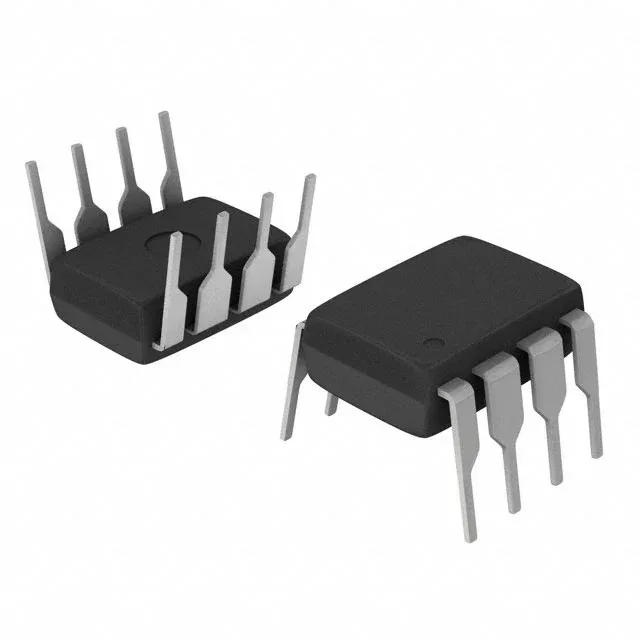
The 8-PDIP footprint is a legacy form factor — no fine-pitch alignment, no thermal pad to worry about. It does, however, consume more board area than an SOIC-8, so if your layout is density-constrained, the SOIC variant (MAX295CSA+) may be a better fit.