Automotive-grade 5A buck for engine-bay and body-electronics rails
The MAX20405AFOD/VY+ is a 5A step-down buck regulator from Analog Devices, qualified to AEC-Q100 Grade 1 — the -40°C to +125°C operating range covers under-hood and cabin electronics where the ambient temperature can hit 105°C on a summer grade and still leave margin. Input voltage spans 3V to 36V, so it starts from a cold-crank battery dipped to 3V and survives a 36V load-dump transient without an external clamp — the internal FET's abs-max rating covers the surge. The single output is programmable from 0.8V up to 10V, with a fixed 3.3V option on the same die, which lets a single BOM line serve both a 3.3V logic rail and a 5V sensor supply by changing the feedback resistor divider.
Switching frequency trade-off and package integration
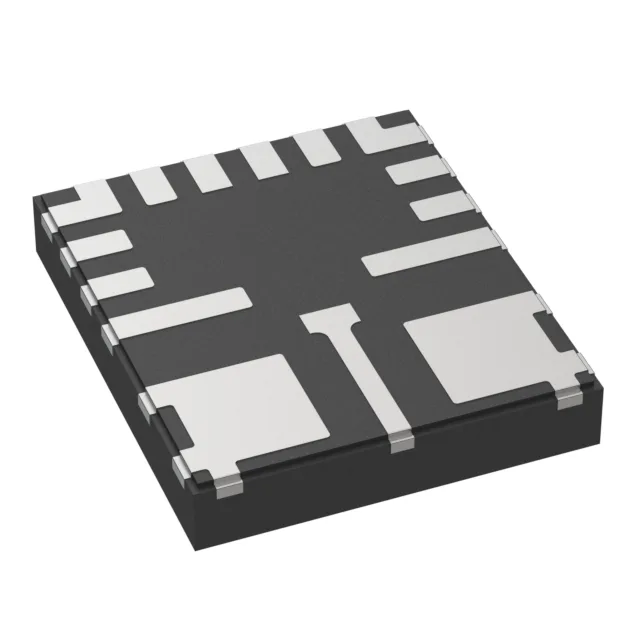
The switching frequency is pin-strapped to either 400kHz or 2.1MHz — at 400kHz the inductor is physically larger but the switching losses are lower, while 2.1MHz shrinks the inductor footprint at the cost of higher gate-drive loss and tighter layout constraints on the switch node. Synchronous rectification is built in, so the external Schottky diode that a non-synchronous buck needs is eliminated — the low-side FET's Rds(on) replaces the diode forward drop, which pulls efficiency up at heavy loads. The 17-FC2QFN package (3.5mm x 3.75mm) with wettable flank terminals allows automated optical inspection (AOI) of the solder joints after reflow — a requirement for many automotive Tier-1 assembly lines that cannot rely on X-ray sampling alone.
Active lifecycle and compliance posture
ROHS3 compliant (exemption-free per EU 2015/863), which means no restricted substances above the threshold limits — relevant for automotive REACH declarations and end-of-vehicle recycling compliance. The AEC-Q100 qualification covers the full automotive stress suite: temperature cycling, ESD (HBM/CDM), latch-up, and extended reliability testing per AEC-Q100-Rev-H. The PPAP documentation is available through the standard Analog Devices channel.