What this boost converter does on your board
The MAX1795EUA+: Input range spans 1V minimum to 5.5V maximum, so it starts up from a nearly depleted cell and handles a full Li-ion charge voltage without a pre-regulator. Output is adjustable from 2V up to 5.5V, with factory-preset options at 3.3V and 5V — the adjustable version lets you dial in an intermediate rail like 3.0V or 3.6V using a resistor divider. The internal switch is rated for 200mA peak current; at typical boost ratios (3V to 5V) this delivers about 100-120mA to the load before the current limit engages.
Switching frequency, rectifier, and temp grade
The synchronous rectifier replaces the usual Schottky diode — this improves efficiency at light loads and eliminates the diode forward drop, which matters when the input is already marginal at 1V.
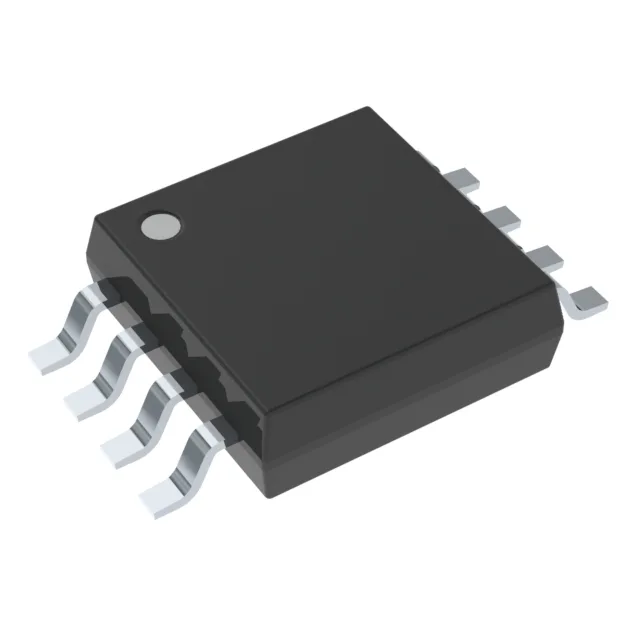
Housed in an 8-pin uMAX/uSOP (MSOP-8) package — 3mm x 3mm body, 0.65mm pitch — it fits on compact layouts where board space is tight, such as sensor modules or wearable PCBs. Supplied in tube format; the surface-mount footprint is standard for MSOP-8, so no special stencil or reflow profile is needed beyond the standard lead-free solder process.
Fully ROHS3 compliant, with no exemptions under the current EU directive; the lead-free finish and halogen-free molding compound meet the requirements for global shipping.