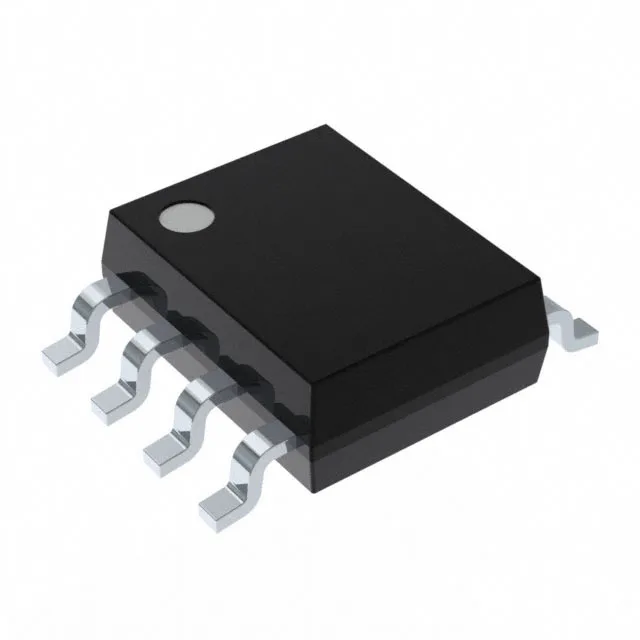
4A peak drive, 40ns rise — what it means for switching losses
The MAX17600ASA+ delivers 4A peak source and 4A peak sink current, with a typical 40ns rise time and 25ns fall time into the gate capacitance of a power N-channel MOSFET. In a 200 kHz buck converter driving a 10 nC gate charge, the switching transition lasts roughly 250 ns — the 4A peak keeps the Miller plateau crossing fast enough that the switching loss stays below 10% of the conduction loss for a 12A output stage.
Supply range and logic thresholds — fits 5V and 12V bias rails
The 4V to 14V supply range covers the two most common gate-drive bias rails: a 5V regulated rail for low-Vgs(th) logic-level MOSFETs, and a 12V rail for standard-threshold power MOSFETs that need the full 10V gate drive to minimise Rds(on).
Two independent low-side channels in one 8-SOIC
Two independent drivers share the 8-SOIC package, each with its own input and output pin. The independent channel type means each driver can switch a separate MOSFET with its own gate resistor — useful for interleaved PFC stages, dual-phase synchronous bucks, or driving the low-side MOSFET in two separate half-bridge legs.
The 150°C TJ max is the absolute limit — derate the output current if the junction temperature approaches this ceiling under continuous high-frequency switching.