Input range and switching frequency — sizing the power stage
The MAX1745EUB+ is a current-mode buck controller that accepts a 4.5V to 36V supply rail, covering standard 5V, 12V, and 24V industrial buses without a pre-regulator. Switching frequency runs up to 330kHz — this sets the inductor value and output capacitor size; a 330kHz design uses smaller magnetics than a 100kHz part but trades higher core loss and switching loss in the external FET. The 100% duty-cycle capability means the output can ride close to the input rail — useful when the input sags near the regulation target, like a battery-backed bus during discharge.
External FET and output stage — what the driver expects
This is a transistor-driver controller — it needs an external N-channel MOSFET and an output inductor to form a complete buck converter. The internal gate driver is sized for the switching frequency range. No synchronous rectifier on-chip, so the low-side is a Schottky diode. That simplifies the layout but costs efficiency at high output current compared to a synchronous design. Single output, positive configuration — one regulated rail per controller. The enable pin lets the system sequencer hold the output off until the upstream rail is stable.
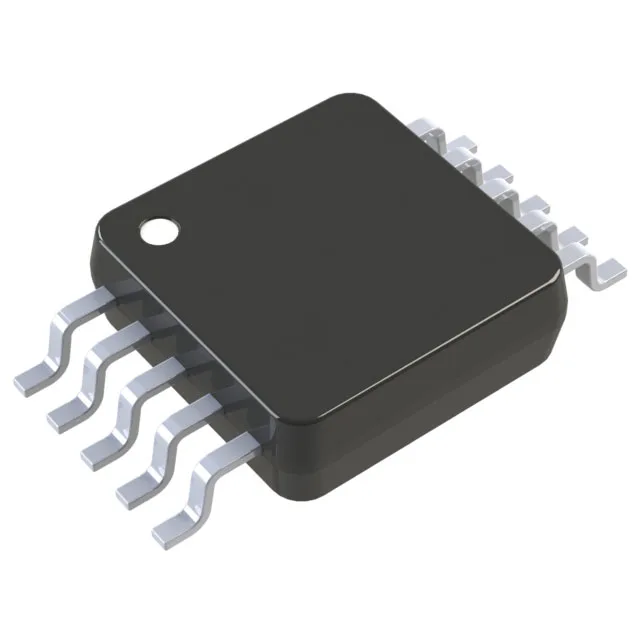
Housed in a 10-uMAX/uSOP (3.00mm width, 0.118" pitch), the MAX1745EUB+ is a surface-mount part suited for compact PCBs. The tube packaging is standard for prototype and low-volume builds. Fine for factory-floor PSUs, telecom line cards, and embedded systems; skip it for under-hood or 125°C environments.
Sourcing and compliance — active, RoHS3, quoted to order
RoHS3 compliant — the + suffix indicates lead-free and meets EU Directive 2015/863.