Buck controller, not a module — what that means for your BOM
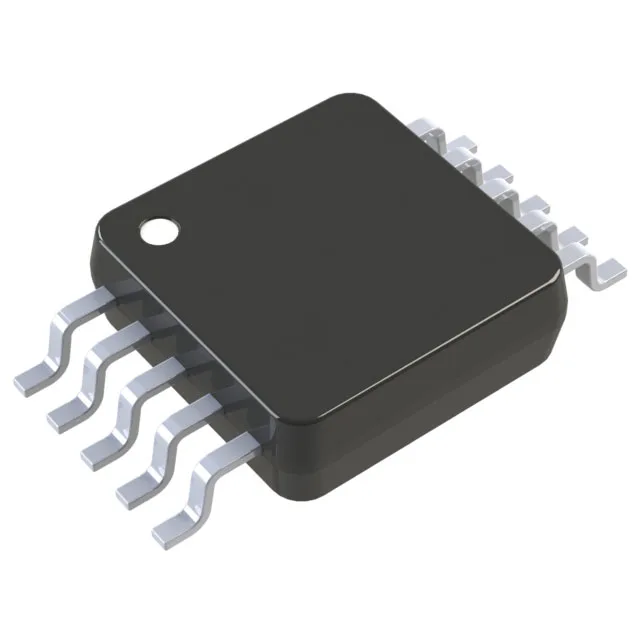
The MAX1744EUB+ is a step-down (buck) controller from Analog Devices, not a module with integrated inductor and passives. It drives an external N-channel FET via its transistor-driver output, so the BOM includes the controller plus the switching FET, catch diode (non-synchronous rectifier), inductor, and input/output capacitors — the external component count and board area are on you, not the package. The 100% maximum duty cycle lets the high-side switch stay on continuously — useful for low-dropout scenarios where the input voltage barely exceeds the output target — but the external FET's bootstrap capacitor still needs a periodic refresh pulse, so the practical dropout floor is a few hundred millivolts above the output. Switching frequency goes up to 330 kHz — that is on the low side for a modern controller, which means larger magnetics (inductor) but lower switching losses in the FET and diode. For a 24 V to 5 V conversion at a few amps, expect a 10-22 µH inductor and a Schottky diode rated for the peak current. No clock-sync input, so you cannot phase-lock it to an external oscillator; if you need synchronized switching across multiple rails, this is not the part.
Package and temp grade — layout and environment constraints
It will survive a factory floor in winter or an outdoor telecom cabinet in summer, but the junction temperature of the external FET and diode, not the controller, will be the thermal bottleneck at high ambient. The controller itself draws only quiescent current from the Vcc pin, so self-heating is negligible.
Active production and compliance — no obsolescence risk
Analog Devices (which now owns the Maxim portfolio) continues to manufacture this part. ROHS3 compliant means no RoHS exemptions; it ships fully lead-free and meets EU and REACH requirements without a waiver. Because it is a controller rather than a module, the second-source options are broader — any buck controller with a similar input range, switching frequency, and package can be evaluated as a drop-in if the external component values are adjusted. No pin-compatible direct replacement is listed from ADI, but the 10-MSOP footprint is common across many controller families.