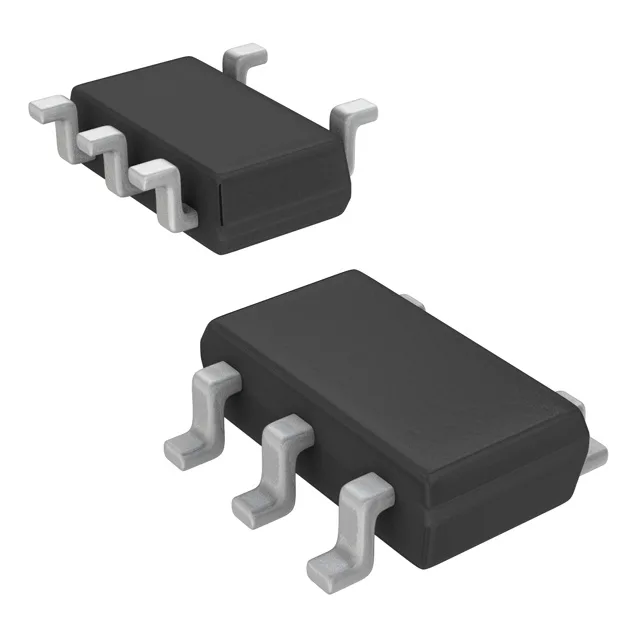
Boost converter with synchronous rectification in a TSOT-23-5 package
The MAX1723EZK+T is a step-up (boost) DC-DC converter from Analog Devices that integrates the switching FET and synchronous rectifier in a 5-pin TSOT-23-5 package. It accepts an input from 0.8 V minimum up to 5.5 V maximum and delivers an adjustable output from 2 V up to 5.5 V, with a 400 mA switch current limit. The 0.8 V minimum input means it can start from a single alkaline cell or a Li-ion battery near its end-of-discharge voltage, making it a candidate for portable and battery-backed applications where the rail must stay alive as the cell sags. The synchronous rectifier replaces the usual external Schottky catch diode with an internal low-Rds(on) FET, which improves efficiency at moderate output currents and simplifies the BOM by one component — the inductor and two ceramic caps are the only external parts needed for a basic boost.
Input and output voltage boundaries for the BOM
The 5.5 V output ceiling matches the input maximum, so this is a low-to-medium voltage boost — not for 12 V or 24 V rails. The 400 mA switch current rating is the peak current the internal FET can handle cycle-by-cycle. In a boost converter, the input current is higher than the output current by the ratio Vout/Vin times efficiency — so at a 3.3 V output from a 1.5 V input, the input current can approach 1 A even though the output load is only a few hundred milliamps. The inductor saturation current and the switch current limit together set the real output capability.
Package, footprint, and supply format
Housed in a 5-pin TSOT-23-5 — a thin version of the standard SOT-23-5 with a lower profile (~1.0 mm seated height). The footprint is the same as a standard SOT-23-5, so existing land patterns for that package work without modification. The TR format is the volume-production reel; CT is for prototype or small-batch builds. Both are surface-mount reflow compatible.
Active lifecycle and compliance standing
This satisfies EU RoHS requirements for equipment placed on the market after 2015.