Boost regulator for low-voltage rails
The Maxim Integrated MAX1709EUI+ is a step-up (boost) switching regulator designed to generate a higher output voltage from a low-voltage input source. It accepts an input from 0.7 V up to 5 V and delivers a regulated adjustable output, with preset options at 2.5 V, 3.3 V, or 5 V. The integrated switch is rated for 7.5 A, making this part suitable for applications that need to pull significant power from a single-cell Li-ion, two-cell alkaline, or USB input. Typical uses include portable instruments, battery-powered equipment, and point-of-load regulation where the input rail can sag below 1 V.
7.5 A switch and wide input range
The 7.5 A switch current rating is the headline power-handling spec for this boost converter. It determines the maximum output current you can draw at a given input-to-output voltage ratio. The switching frequency is programmable between 350 kHz and 1 MHz. A lower frequency reduces switching losses and improves efficiency at light loads, while a higher frequency allows smaller external inductors and capacitors. The trade-off is between board area and thermal performance. The part does not include synchronous rectification, so the external Schottky diode must be selected for the peak switch current and output voltage.
Package and thermal handling
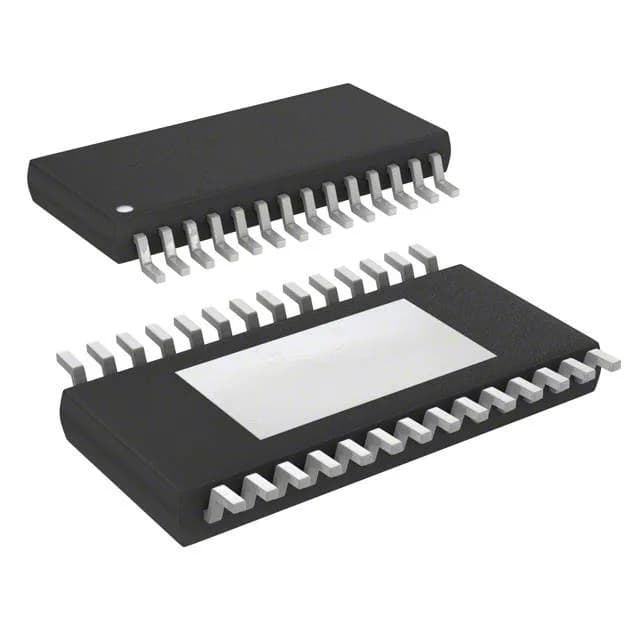
The MAX1709EUI+ is housed in a 28-pin TSSOP with an exposed pad (28-TSSOP-EP). The exposed pad must be soldered to a thermal land on the PCB to dissipate heat from the internal switch. The package footprint is 4.40 mm wide, typical for TSSOP-28, and the pad provides a low-thermal-resistance path to the board. For a boost converter delivering several amps, the PCB copper area under the pad is part of the thermal design.
Lifecycle and sourcing
The MAX1709EUI+ is listed as Active on the manufacturer's lifecycle status, with no NRND or last-time-buy notice. It is ROHS3 compliant. For BOM planning, this part carries no imminent obsolescence risk and can be specified into new designs with confidence.