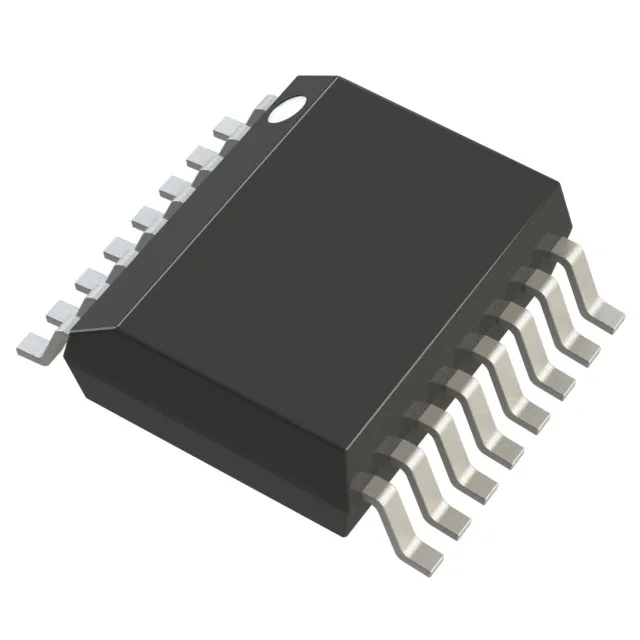
Boost converter, not an MCU
The MAX1706EEE+: It delivers up to 550 mA via the internal switch, with an adjustable output from 2.5 V up to 5.5 V, making it suitable for generating a higher-voltage rail from a single-cell Li-ion or multi-cell alkaline input.
Input range and output flexibility
The input range spans 0.9 V minimum to 5.5 V maximum — the 0.9 V floor allows operation from a nearly depleted single-cell battery, while the 5.5 V ceiling matches the max output, so the part cannot boost beyond its input voltage limit. Output is adjustable via external feedback resistors; the minimum fixed starting point is 2.5 V, and the positive output configuration means no inverting topology is needed for this rail.
Switching frequency and inductor selection
The switching frequency is trimmed to 260 kHz to 340 kHz — a narrow band that simplifies inductor selection and keeps the EMI fundamental below 400 kHz, where conducted emission limits are easier to meet. No synchronous rectifier is used internally, so the external Schottky diode handles the catch current; the 550 mA switch rating is the peak current the internal NPN can handle, not the continuous output current, which will be lower depending on the input-to-output voltage ratio.
Housed in a 16-pin SSOP (0.154-inch body width, 3.90 mm) with an alternate 16-QSOP supplier device package — both are surface-mount, fine-pitch footprints suited for compact portable or industrial PCBs.