The MAX16990ATCD/V+: ROHS3 compliant — no RoHS exemption expiry to track for EU or similar regulated markets.
AEC-Q100 Grade 1 — under-hood temperature band
A cabin-grade part (Grade 2, -40°C to +105°C) would derate or fail in the same thermal profile. The 4.5V to 36V supply range (Vcc/Vdd) covers a 12V automotive nominal rail with margin for cold-crank dips to 4.5V and load-dump transients up to 36V — no external pre-regulator or clamp is required for the controller itself.
Boost and SEPIC topology — one controller, two jobs
The MAX16990ATCD/V+ supports both boost and SEPIC topologies from a single controller. For a boost, the output is always above the input; for a SEPIC, the output can be above, below, or equal to the input — useful when the battery voltage crosses the regulated rail (e.g., a 12V rail from a battery that swings 9V to 16V). Switching frequency is programmable from 220 kHz to 1 MHz, and the part accepts an external clock sync input — useful for shifting the switching harmonics away from a sensitive RF band or sensor front-end. Maximum duty cycle is 93%, which sets the practical step-up ratio ceiling. For a 12V nominal input, the output can reach roughly 170V before the duty-cycle limit forces a two-stage approach.
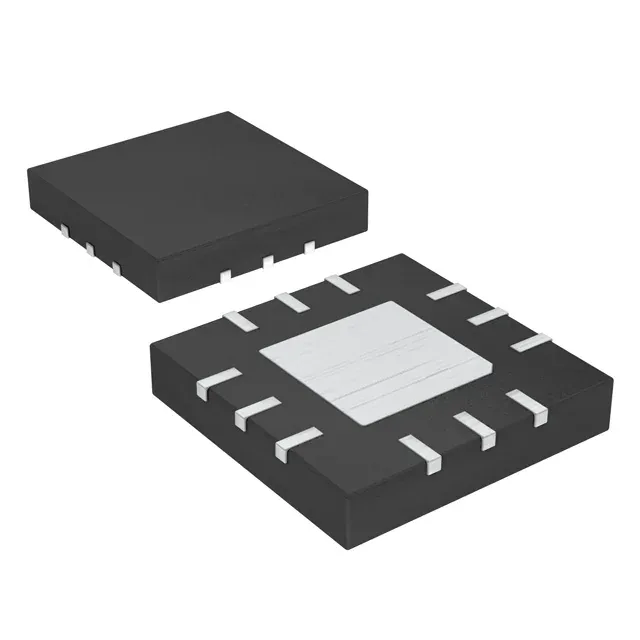
Housed in a 12-WFQFN with exposed pad (3x3 mm body, supplier package 12-TQFN), the thermal pad underneath the package is the primary junction-to-board heat path. The part is a non-synchronous controller — it drives an external N-channel MOSFET and requires an external Schottky catch diode. The efficiency penalty vs a synchronous design is roughly 2-4% at full load, but the BOM cost is lower and the layout is simpler.
Control interface — what the MCU talks to
The controller exposes current limit, enable, frequency control, and power-good signals. These map directly to MCU GPIOs for sequenced startup, fault handling, and frequency dithering. The power-good output is an open-drain flag that asserts when the output is within regulation — useful for feeding into a system reset or a load-enable gate. Output configuration is positive, single phase, single output — a straightforward single-rail controller with no multi-phase complexity.