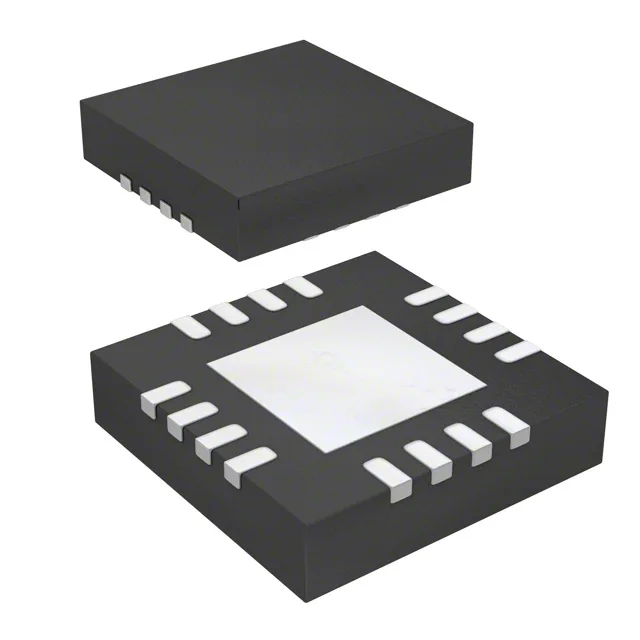
Active lifecycle — no LTB window to manage
The MAX16907RATE/V+: ROHS3 compliant per the manufacturer's RoHS status, so it meets the latest EU directive for lead-free soldering processes without an exemption expiry.
3 A output with wide 3.5-36 V input — automotive bus-ready
Rated for 3 A continuous output with a single adjustable output configurable from 1 V to 10 V. The 3.5 V minimum input covers cold-crank conditions on a nominally 12 V automotive bus, while the 36 V maximum handles load-dump transients without an external clamp — the internal FET's abs-max rating covers the surge. Switching frequency is fixed at 2.2 MHz, pushing the fundamental switching noise above the AM band and allowing a physically small inductor — a 2.2 µH to 4.7 µH part in a 1212 or 1616 footprint typically fits the loop. No synchronous rectifier, so the external Schottky diode's forward voltage and reverse leakage must be factored into the thermal budget at high input voltage.
AEC-Q100 Grade 1 — -40 to +125 °C junction range
Qualified under the AEC-Q100 automotive IC standard with an operating junction temperature range of -40 to +125 °C. This is the Grade 1 band — suitable for under-hood and engine-bay environments where ambient can reach 105 °C on a summer day, leaving 20 °C margin for self-heating at full load. The datasheet's thermal impedance figures assume a 2 oz copper plane on the inner layers — a layout without the thermal vias will see junction temperature rise 15-20 °C above the spec table value.