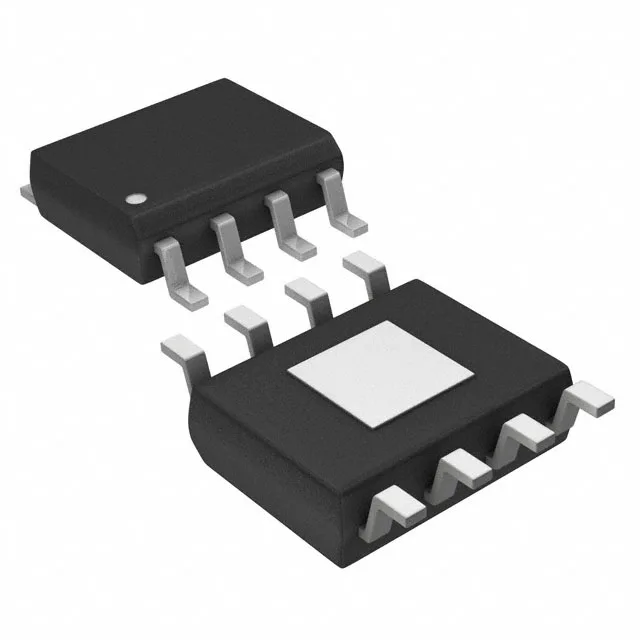
What the 2 MHz switching frequency buys you
The MAX16832AASA+T runs a fixed 2 MHz switching frequency on the buck converter — high enough to push the inductor ripple well above the audible band and shrink the magnetics to a small footprint 0805 or 1210 chip inductor. The switching loss at 2 MHz is manageable because the internal switch handles only 700 mA, so the gate-drive power stays low enough that the 8-SOIC exposed pad can sink the heat into a modest copper pour. At 2 MHz the output ripple is dominated by the output capacitor ESR, not the inductance — a 10 µF ceramic with 3 mΩ ESR keeps the ripple under 10 mVpp at full load. The trade-off is that the high-side switch transitions happen every 500 ns, so the PCB layout needs tight loops between the input cap and the VIN pin to keep switching noise off the sense resistor ground path.
Input range and what it means for the string
Wide 6.5 V to 65 V input range means this single part covers everything from a 12 V automotive battery (cold-crank dips to 6.5 V) up to a 48 V industrial rail or a 60 V nominal LED string. The internal switch is rated to handle the full 65 V max without an external clamp — the only external passives are the inductor, sense resistor, and output cap. The 700 mA per channel is a constant-current regulated output, not a voltage rail — the sense resistor sets the current, and the buck regulates the duty cycle to hold that current regardless of how many series LEDs are in the string (up to the compliance voltage of the input rail minus dropout). For a typical 3 W LED at 700 mA, the forward voltage is around 3.2 V, so a 12 V input can drive up to three series LEDs with headroom.
PWM dimming — what the interface expects
The dimming input accepts a PWM signal — the internal logic gates the switching on and off at the PWM rate, so the average current through the LED string follows the duty cycle linearly down to single-digit percentages. The PWM frequency should stay below 1 kHz to avoid visible flicker; at 200 Hz the human eye integrates the pulses smoothly down to 1 % duty. The PWM pin is a logic-level input — it does not carry the LED current, so no external driver is needed. The PWM-off state shuts down the internal oscillator and the switch, dropping the quiescent current to microamps.
Available through independent distribution channels. No minimum order threshold for spot buys; tray or reel quantities as available.