LED controller with multi-topology flexibility
The MAX16814ATP/V+: It operates as a DC-DC controller and requires external switches, giving the designer control over the power stage component selection. The controller supports SEPIC, step-down (buck), and step-up (boost) topologies, making it adaptable to a wide range of LED string voltages and input rail conditions.
Output channels, dimming, and current per string
Four independent output channels each rated for 150 mA — this is the per-channel current limit, not the total driver output. For a typical backlight with multiple LED strings, each channel drives one string; the total LED current is the sum of the four channels. Dimming is controlled via PWM, which means the LED current is switched on and off at a duty cycle to control brightness. The PWM frequency is independent of the switching frequency, so the designer can set the dimming rate without affecting the inductor ripple.
Supply voltage range and temperature grade
The input supply range spans 4.75 V minimum to 40 V maximum. The 4.75 V minimum means it starts from a standard 5 V rail with margin; the 40 V maximum covers automotive battery transients and 24 V industrial rails without an external clamp. Operating temperature range is -40°C to +125°C — this is the full automotive-grade temperature band. An engine-bay or exterior lighting module that sees 105°C on a hot day still has margin to the 125°C limit.
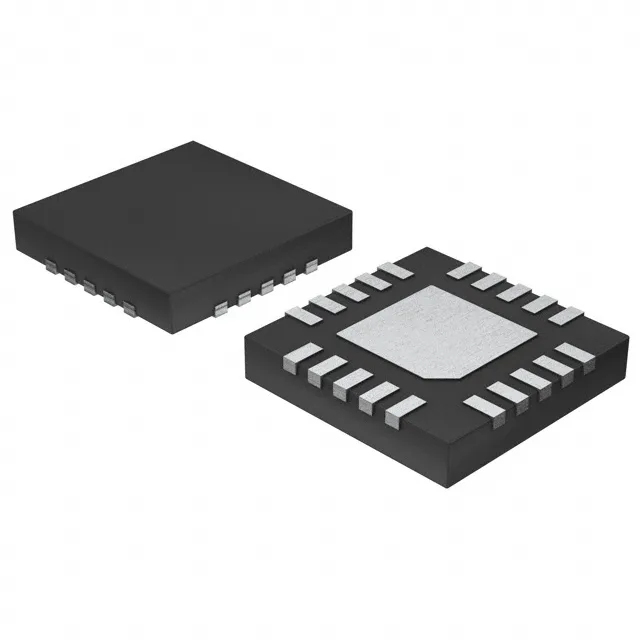
Housed in a 20-WFQFN exposed-pad package with a 4x4 mm body.