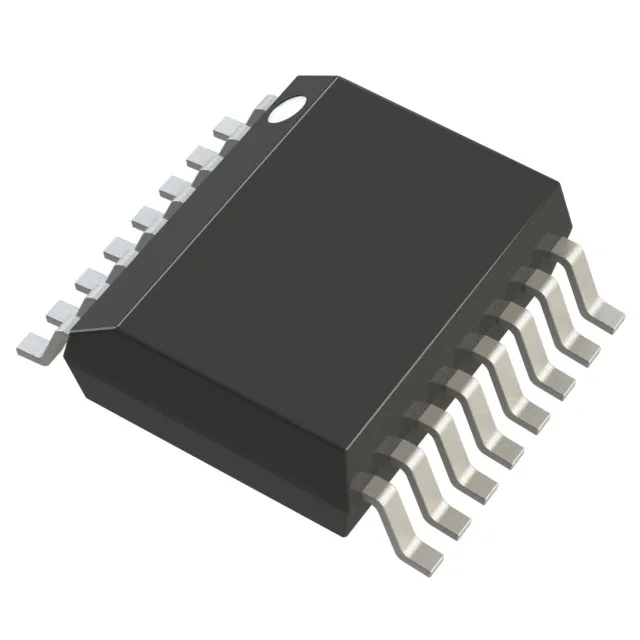
The MAX1672EEE+T comes in a 16-SSOP (0.154", 3.90mm width) package, also specified as the supplier device package 16-QSOP. The narrow-body SSOP footprint is standard for this pin count, with a 0.025" pitch that routes cleanly on a two-layer board for a simple power supply design. Tape & Reel (TR) and Cut Tape (CT) options are listed — the TR variant is the standard reel quantity for pick-and-place assembly; the CT option suits prototype or low-volume builds where the reel minimum is too large.
Buck-boost topology and input flexibility
This is a step-up/step-down (buck-boost) regulator with a single 300mA output. The output is adjustable (programmable) with a minimum/fixed option of 1.25V, and a maximum of 5.5V. The 1.25V reference is the standard feedback threshold for the external resistor divider; the 3.3V and 5.5V fixed options are set by internal divider taps, saving two external resistors. No synchronous rectifier is used — the external Schottky diode adds a forward-voltage drop but keeps the BOM cost low and avoids the shoot-through risk of a synchronous FET at light loads. The positive output configuration means the inductor and diode sit between the input and output, not inverted.
The regulator's internal compensation and switching frequency are trimmed to maintain regulation across this band — expect the output voltage to drift within the datasheet's load/line regulation specs, not to shift outside the adjustable range. At the 85°C end, the 300mA output current is derated by the package's thermal impedance (θJA for the 16-QSOP is typically 120-150°C/W). A 300mA load at 5V output with 90% efficiency dissipates about 170mW, keeping the junction temperature below 110°C at 85°C ambient — within the die's absolute maximum.
ROHS3 Compliant — the part meets the latest EU RoHS exemption rules, including the 10-substance restriction. No additional compliance documentation (REACH, UL, IEC) is listed in the record; the ROHS3 declaration is the primary regulatory signal for EU market placement.