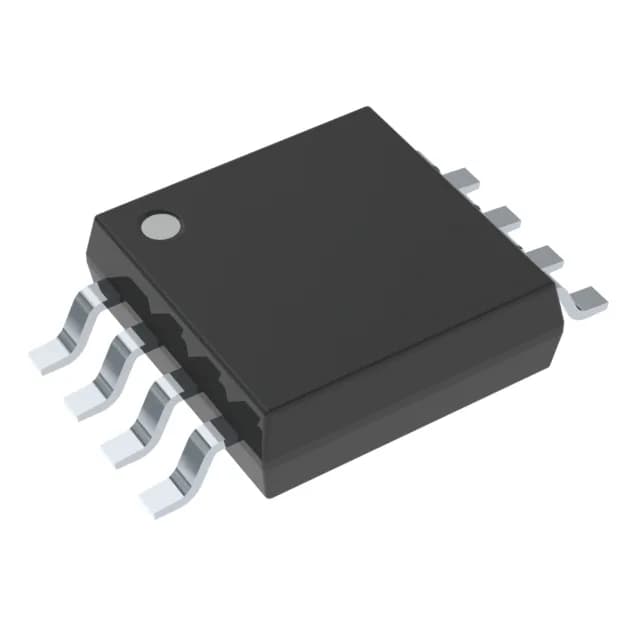
Package and mounting
The Maxim Integrated MAX1606EUA+T is a current-mode step-up (boost) converter that takes a 2.4V to 5.5V input and delivers an adjustable output up to 28V through a single integrated 350mA switch. It runs at a fixed 500kHz switching frequency, which keeps the external inductor and output capacitor physically small — useful when you are squeezing a bias rail into a tight layout. The part is not synchronous (no internal rectifier), so the standard application uses a Schottky diode on the output; that diode drop eats into efficiency at high step ratios, but for moderate boosts the simplicity wins. Rated over -40°C to 85°C, so it fits portable or outdoor gear that sees temperature swings.
28V output — where that matters
The headline number here is the 28V maximum output. That puts this part squarely into LCD bias generation, OLED VCOM rail, or APD bias for optical receivers — applications where you need a clean, adjustable 15V–28V rail from a 3.3V or 5V supply. The adjustable output (set by an external resistor divider, down to 0.8V minimum) means you are not locked into a fixed voltage; you trim it for the load. The 350mA switch current is the limit on the primary side — actual output current available depends on the ratio of Vout to Vin. At 28V out from 3.3V in, you are looking at roughly 40 mA continuous; at 12V out from 5V in, closer to 130 mA. Plan your load accordingly.
Package and footprint
The MAX1606EUA+T comes in the 8-lead µMAX (also called uSOP or MSOP-8) package, with a 3.00 mm body width. It is a surface-mount part, and the datasheet recommends a standard MSOP-8 footprint. If you need a smaller quantity for prototyping, Cut Tape (CT) is available through the same order code.
Lifecycle and sourcing
The MAX1606EUA+T is listed as Active on the manufacturer's status and carries ROHS3 compliance. If you are looking for a pin-compatible alternative, the closest sibling in the same family is the MAX1605EUA+T; it shares the same footprint and pinout but offers a slightly different switch current rating. For dual-sourcing or a second-source hedge, that is the one to qualify.