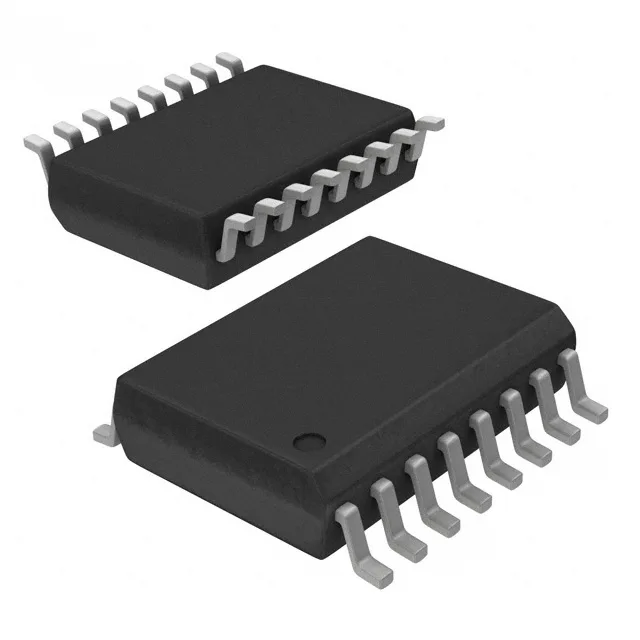
14-bit SAR at 308k SPS — what the sampling rate means for your signal chain
The MAX121EWE+ is a 14-bit successive-approximation-register (SAR) ADC from Analog Devices, sampling at 308k samples per second. At this rate, the converter captures one full 14-bit word every 3.25 µs — fast enough to digitize a 150 kHz bandwidth signal under Nyquist, or to oversample a lower-frequency sensor for noise reduction. The single-ended input accepts one channel, with a 1:1 S/H-to-ADC ratio, meaning the sample-and-hold captures the input voltage directly before conversion starts. The SPI data interface keeps the digital side clean — four wires (SCLK, MOSI, MISO, CS) carry the conversion result to the host controller without the pin count of a parallel bus. For a 14-bit word at 308k SPS, the SPI clock needs to run at roughly 4.3 MHz minimum to keep up with the throughput; a 10 MHz SPI clock gives margin for framing overhead.
Supply rails and reference — dual-voltage flexibility
The analog and digital supplies both accept 5 V, with the analog rail also tolerating a -10.8 V to 15.75 V range — this second negative supply lets the ADC handle bipolar input signals without external level shifting. The reference can be either external or internal, giving the designer control over the full-scale range: an external precision reference improves gain accuracy and temperature drift, while the internal reference simplifies the BOM for single-supply systems.
Industrial temperature grade and SOIC-16 footprint
Tube packaging means the parts arrive in anti-static tubes of 48 or 50, suitable for hand-assembly or low-volume pick-and-place.