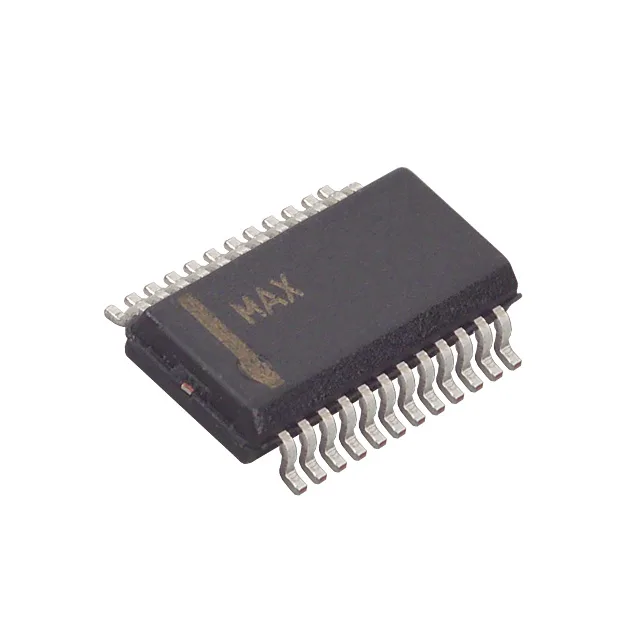
Active production status and supply posture
The MAX11624EEG+: ROHS3 compliant, so it slots into EU and global assemblies without a waiver or exemption review.
Sampling rate and channel count for multi-sensor acquisition
300 ksps at 10-bit resolution — that is 300,000 conversions per second. With 16 single-ended inputs, the per-channel throughput when scanning all channels sequentially is about 18.75 ksps per channel. If your application only needs four channels, the per-channel rate jumps to 75 ksps. The SAR architecture means each conversion completes in a single clock cycle — no pipeline delay, so the first sample after a channel switch is valid immediately. The 1:1 S/H-to-ADC ratio confirms there is one sample-and-hold feeding the converter — the input multiplexer switches the S/H capacitor to the selected channel before each conversion. For DC or low-frequency signals this is transparent; for higher-frequency inputs, the acquisition time of the S/H sets the maximum input bandwidth.
Supply rail and interface — single 5V system
Both the analog and digital supply rails are specified at 5V — one rail runs the ADC core and the SPI interface logic. This simplifies the power tree: a single 5V bus from a regulator or system rail powers the device, and the SPI output levels are 5V-compatible, so it connects directly to 5V-tolerant MCU SPI ports without a level shifter. The external or internal reference option (Reference Type: External, Internal) means you can use the on-chip bandgap reference for moderate accuracy, or drive an external precision reference for tighter absolute accuracy and lower drift. The internal reference is typically adequate for 10-bit accuracy — the LSB size at 5V reference is 4.88 mV.
The 0.025-inch (0.635 mm) pin pitch is a standard fine-pitch SSOP/QSOp layout; two-layer boards can route it with a reasonable fan-out, though a ground plane under the device is recommended for noise coupling reduction on the analog inputs. This covers factory-floor enclosures, outdoor telecom cabinets, and automotive cabin environments (non-engine bay). The SAR core's offset and gain drift over temperature are specified in the datasheet; for a 10-bit system the drift is usually negligible, but budget the reference drift if using the internal reference.