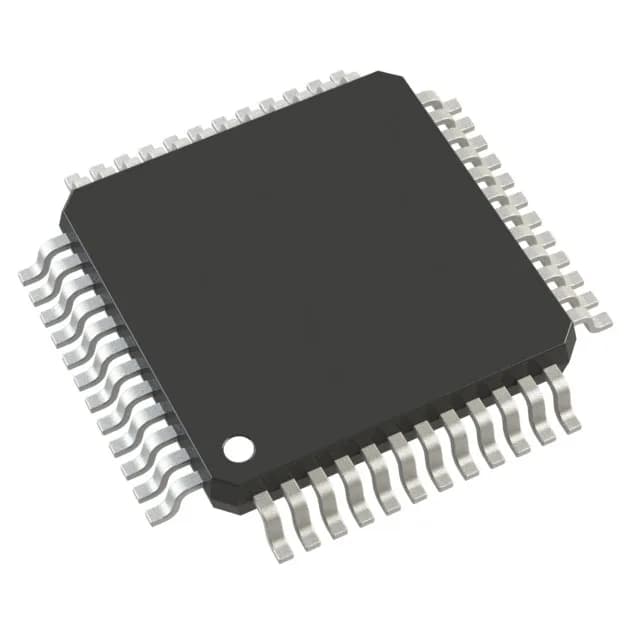
What this part is — a 20-channel configurable mixed-signal I/O
The Maxim Integrated MAX11300GCM+ is a PIXI™-series configurable mixed-signal device that integrates both a 12-bit ADC and a 12-bit DAC on a single die, accessible through 20 independent channels. Each channel can be individually configured as an analog input, analog output, digital I/O, or GPIO, which makes this part a dense, flexible analog front-end for systems where board space is tight and signal routing needs to be reconfigurable. The SPI data interface handles configuration and data transfer, and the supply range of 1.62 V to 5.5 V lets it operate on 1.8 V, 3.3 V, or legacy 5 V rails without a separate level shifter. Sampling rate per channel runs at 400 ksps — fast enough for real-time control loops and multi-channel data acquisition in industrial automation, test equipment, and sensor hub designs.
Supply voltage range — one part for 1.8 V, 3.3 V, and 5 V buses
The 1.62 V to 5.5 V supply range is the key cross-platform spec. It means the MAX11300GCM+ can be dropped into a 1.8 V core-logic board, a 3.3 V sensor interface, or a 5 V legacy PLC module without adding a separate regulator or translation buffer. The analog and digital supply sources are independent — you can run the analog core at 5 V for best dynamic range and the digital interface at 3.3 V for a lower-power MCU bus. This flexibility saves BOM cost and board area, but it does require careful decoupling at each supply pin; the exposed pad underneath the 48-TQFP package should be stitched to the analog ground plane with multiple vias to keep return currents clean.
Temperature grade and operating environment
Rated for -40°C to 105°C, this part fits industrial environments — motor drives, outdoor telecom enclosures, factory-floor sensor nodes, and under-hood automotive auxiliary systems (though it is not AEC-Q100 listed). The 105°C ceiling means it can handle self-heating from the 20 channels running simultaneously in a warm cabinet without derating. The 48-TQFP-EP package with its exposed pad is the thermal path; without the pad soldered to a copper plane, junction temperature will climb quickly above 85°C ambient. This is not a part for a sealed plastic enclosure with no airflow unless you budget for forced convection or a heatsink.
Lifecycle and sourcing reality
The device is ROHS3 compliant, so it meets the latest environmental directives for European and Asian markets.