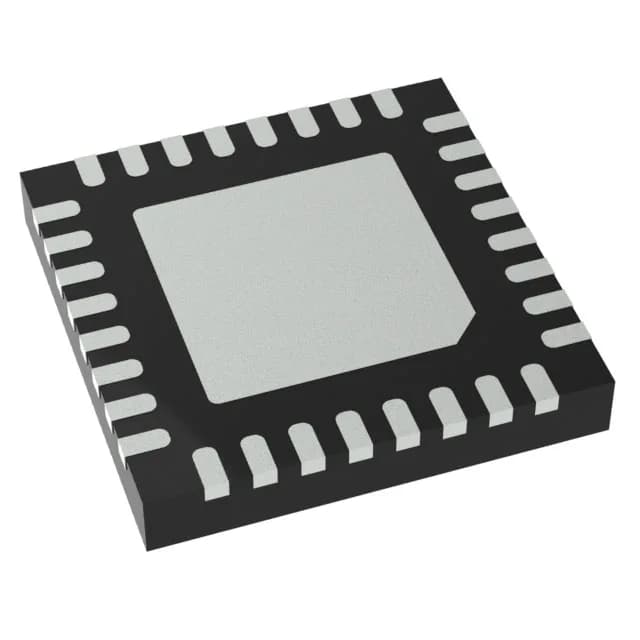
Dual-output buck-boost controller for non-synchronous rails
The LTC7812HUH#PBF is a dual-output, non-synchronous switching regulator controller from Analog Devices that handles both step-up (boost) and step-down (buck) topologies. It drives external N-channel MOSFETs from a single supply rail of 4.5 V to 38 V, making it a fit for intermediate bus conversion in industrial, automotive, and telecom equipment where the input voltage can swing above and below the regulated output. The controller operates over a -40°C to 150°C junction temperature range, so it can sit on a board near a hot power stage or inside an engine-bay enclosure without derating concerns.
Switching frequency and output flexibility
Two independent switching-frequency ranges are available: a wide band from 115 kHz to 835 kHz, and a narrower band from 350 kHz to 535 kHz. The lower end suits designs where efficiency and thermal management take priority; the upper end shrinks the magnetics and output capacitors. Each of the two outputs can be configured independently as a buck or a boost, and the controller supports a maximum duty cycle of 96% for the buck channel and 99% for the boost channel. Control features include enable, frequency control, power-good flag, soft-start, and tracking — enough to sequence multiple rails without an external supervisor.
Package and mounting
Housed in a 32-lead WFQFN with exposed pad (5 mm × 5 mm body), the LTC7812HUH#PBF is a surface-mount part. The exposed pad must be soldered to a thermal land on the PCB — the datasheet layout recommendation shows a grid of vias under the pad to pull heat into the inner copper planes. The part ships in a tube; if your pick-and-place line expects tape-and-reel, confirm the reel option (LTC7812HUH#TRPBF) before ordering.
Lifecycle and sourcing
Marked as Active on the manufacturer's product status. No last-time-buy or end-of-life notice is in effect. The part is ROHS3 compliant. For BOM planning, this means no forced redesign from obsolescence in the near term.