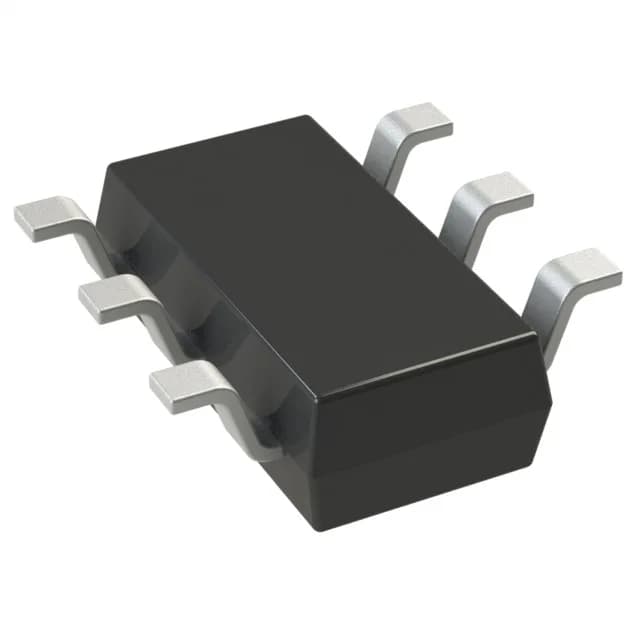
The LTC6995IS6-2#TRMPBF is a silicon oscillator from the TimerBlox® family, designed to generate programmable timing signals from 29.1 µHz up to 977 Hz without an external crystal or ceramic resonator.
Frequency range — what the 29.1 µHz to 977 Hz span actually buys you
The headline range of 29.1 µHz to 977 Hz covers ultra-low-frequency timing — think watchdog timeouts measured in minutes or hours, periodic wake-up intervals for a battery-powered sensor node, or a slow PWM for a heater element. At the low end, 29.1 µHz corresponds to a period of roughly 9.5 hours, so this part can replace a discrete RC or a long-counter chain for infrequent events. The upper end at 977 Hz is still sub-kHz, so it is not for switching regulators or audio clocks; it is for event timing, interval generation, and system supervision where accuracy and stability matter more than speed.
Supply and current — sizing the rail and the battery budget
The 135 µA typical supply current is low enough that a coin cell can keep the oscillator alive for years in a wake-up timer role, but it is not a nano-power device — if your sleep budget is under 1 µA, this part needs its own enable switch or a dedicated power domain.
It is also ROHS3 compliant.
Package and marking — what to verify on receipt
This part comes in a TSOT-23-6 package (the thin SOT-23-6 variant), which is a surface-mount footprint. The supplier device package is TSOT-23-6. When inspecting incoming stock, check that the laser-etched top mark matches the Analog Devices font and date-code format for the plant and week — counterfeit lots have been caught with mismatched font geometry on this family. The TSOT-23-6 body is thin, so reflow profiles should follow the JEDEC standard for small-outline packages; no special bake is needed if the moisture barrier bag is intact.