I²C bus isolator with magnetic coupling — no isolated supply needed
It runs at a 100kHz data rate and does not require an isolated power supply on the secondary side — the device draws its bias from the bus-side supply rails, which simplifies the BOM for a split I²C bus.
20kV/µs CMTI — what it means for a motor-drive or inverter bus
Common-mode transient immunity is rated at 20kV/µs minimum. In a motor drive or industrial inverter where the switching edges on the high-voltage rail couple fast transients across the barrier, that figure tells you the isolator won't glitch or latch the I²C data. The 1ns typical rise and fall times keep the bus edges clean enough for the 100kHz clock rate.
Supply range and 3.3V compatibility
The supply range spans 3V to 5.5V, so it works on a 3.3V I²C bus as well as a 5V bus. The two channels are unidirectional — one from Side 1 to Side 2 (typically SDA), one the opposite direction (SCL) — matching the standard I²C topology where each line needs its own direction.
Package and temperature grade
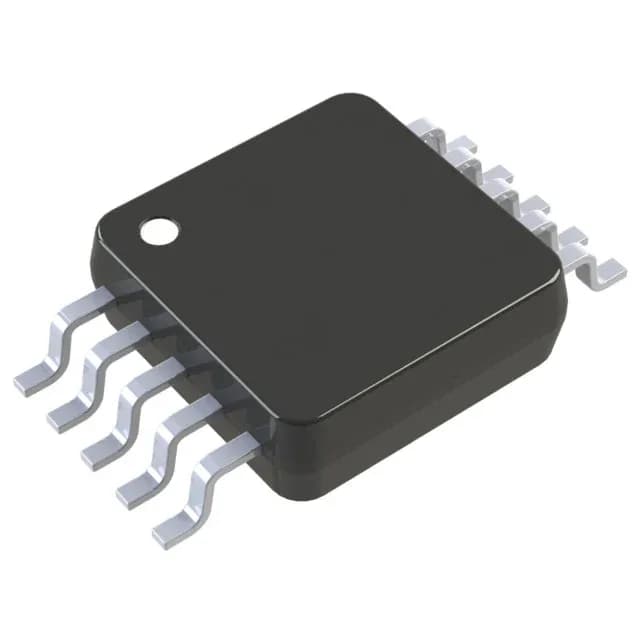
Housed in a 10-MSOP (3mm × 3mm body), it's a surface-mount part that reflows without special handling — MSL 1 or 2 per the usual Analog Devices MSOP profile.