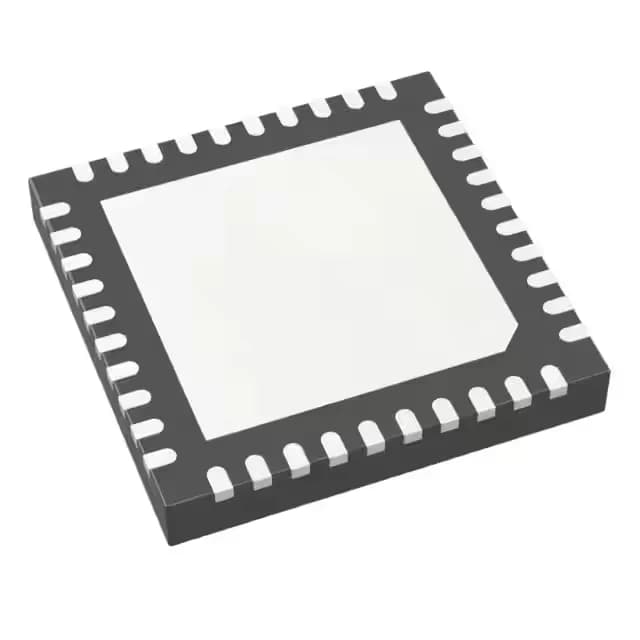
Three-phase synchronous buck controller for dense POL rails
The LTC3853EUJ#PBF is a three-phase synchronous buck controller from Analog Devices, designed for step-down conversion where output current demands exceed what a single phase can deliver efficiently. Three interleaved output phases share the load, reducing input and output ripple and spreading thermal dissipation across the board — useful for high-density point-of-load rails in telecom, datacom, and industrial equipment. The controller drives external N-channel MOSFETs and includes synchronous rectification, so efficiency holds up at lower output voltages where a Schottky catch diode would dominate losses. Supply range spans 4.5 V to 24 V. Switching frequency is adjustable from 250 kHz to 750 kHz.
What the three-phase architecture buys you
Compared to a two-phase controller like the LTC3850EGN-1#PBF, the LTC3853EUJ#PBF adds one output phase (3 vs 2) and extends the operating temperature range from 85°C ambient to 125°C junction (vs). The extra phase cuts per-phase inductor current and output ripple amplitude, which lets you use smaller output capacitors and spread the thermal load across an additional inductor and MOSFET set. The 125°C junction rating is the deciding factor if the board sits in a sealed enclosure or near a hot air exhaust — the LTC3850 peers top out at 85°C ambient, which is marginal for forced-air or outdoor environments.
Control features and layout considerations
Control features include current limit, enable, frequency control, power good, soft start, and output tracking. The tracking input lets the output voltage follow another rail during startup.
Lifecycle and sourcing posture
The LTC3853EUJ#PBF carries an Active lifecycle status and is ROHS3 compliant. There is no NRND flag or last-time-buy notice on this part, so it remains a valid selection for new designs and production builds. No direct second-source alternate is listed in the record, but the two-phase LTC3850 family (LTC3850EGN-1#PBF, LTC3850IUF#PBF, LTC3850EUFD#PBF) shares the same control feature set and buck topology if a lower-phase-count drop-in is acceptable for a parallel build.