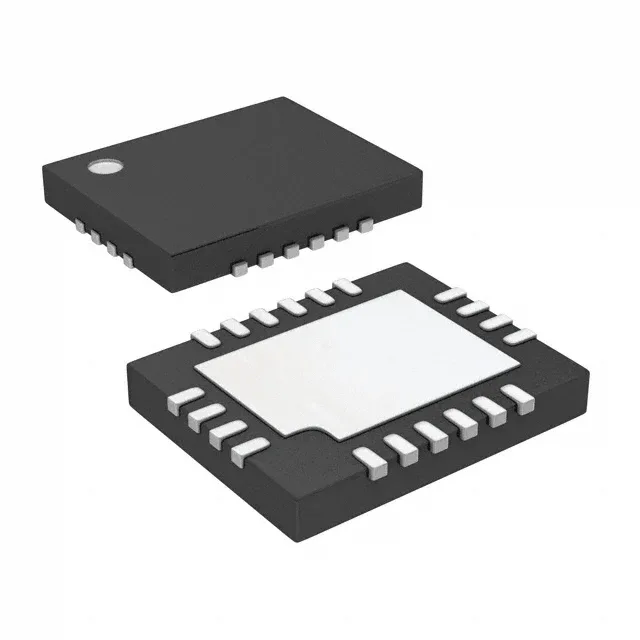
Octal 16-bit DAC with SPI — what the key specs mean for the BOM
The LTC2656BCUFD-H16#PBF: Eight 16-bit DACs in a single 20-QFN package — this consolidates what would otherwise take eight separate converters, saving board area and per-channel procurement overhead. The 7.9 µs typical settling time sets the per-channel update rate ceiling: at 16 bits, each channel can settle to 1 LSB in under 8 µs, which supports closed-loop control loops updating at tens of kilohertz without the output lagging the setpoint. The SPI data interface keeps the digital-side pin count low — four wires (SCK, SDI, SDO, CS) control all eight channels. This simplifies isolation if the DAC sits on a different ground domain from the controller, and allows daisy-chaining multiple LTC2656 devices on a single bus without extra GPIOs. INL of ±2 LSB and DNL of ±0.3 LSB mean the output linearity is monotonic across the full 16-bit range — no missing codes, and the error budget stays within 0.003% of full scale. For a 0–5 V output span, that is roughly 150 µV of integral nonlinearity, which is negligible for most industrial setpoint and trimming applications. The reference can be internal or external — using the internal reference keeps the BOM simple for absolute-output applications; an external reference allows ratiometric operation where the DAC output tracks a system reference voltage (e.g., a sensor excitation supply).