Why the 1 µV offset matters for precision measurements
The LTC2051IMS8#TRPBF is a dual-channel zero-drift (chopper) operational amplifier from Analog Devices. Its key differentiator is a maximum input offset voltage of 1 µV, achieved through an auto-zero architecture that continuously corrects for DC errors. This makes it the part to reach for when a standard op-amp's drift would walk the output out of tolerance over temperature or time — think thermocouple amplifiers, load-cell signal chains, or any precision DC measurement where a few microvolts of drift would be a failed calibration.
Supply range and single-supply operation
The rail-to-rail output swings within millivolts of each supply, preserving dynamic range in low-voltage systems. Quiescent current is 1 mA per amplifier, so a dual-channel design draws about 2 mA total — reasonable for battery-powered instrumentation that needs to stay on for extended periods.
The 2V/µs slew rate and 3 MHz gain-bandwidth product are modest numbers, but they are consistent with the zero-drift topology. This is not a high-speed amplifier; it is built for accuracy, not speed. For a unity-gain buffer sampling a 10 kHz signal, the 3 MHz GBW provides plenty of closed-loop gain margin. If you need to amplify a 100 kHz sine wave with low distortion, look elsewhere — the chopper switching artifacts and limited slew rate will start to degrade the output.
Package and footprint for layout
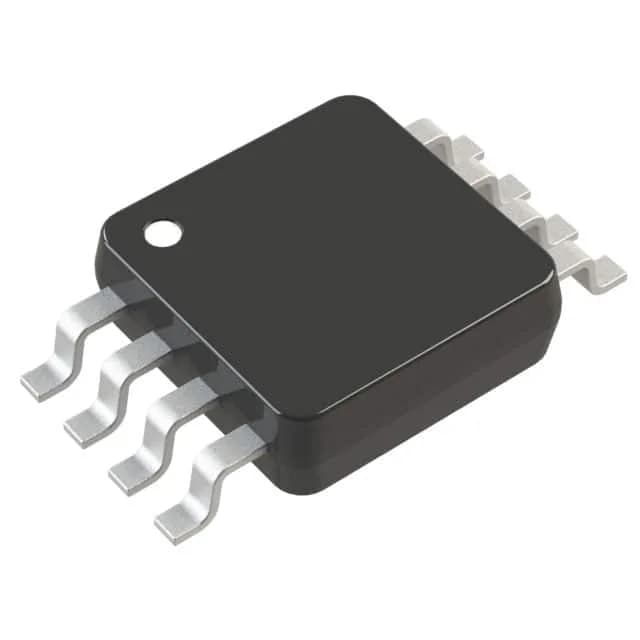
The supplier device package is 8-MSOP, which is the same footprint as the 8-TSSOP option listed in the case description. The Tape & Reel suffix (#TRPBF) indicates it ships on a 7-inch reel, typically 2500 pieces per reel, for automated pick-and-place assembly.