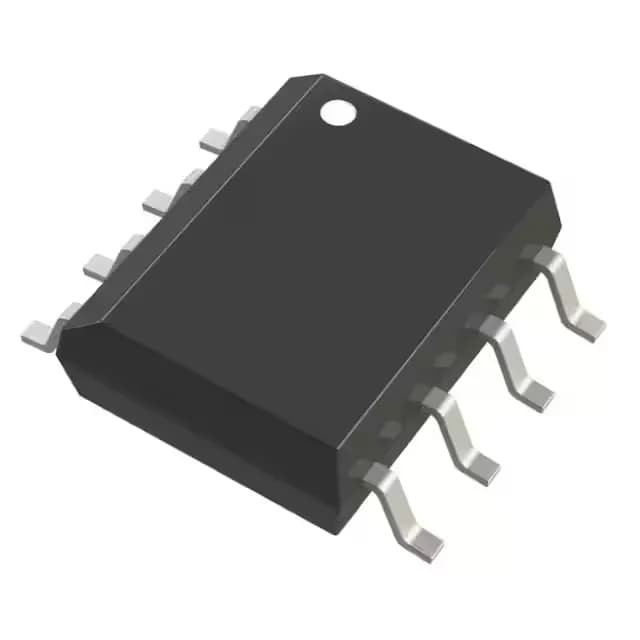
Zero-drift precision in an 8-SOIC — what the 5 µV offset buys you
The LTC1250CS8#PBF is a single-channel zero-drift operational amplifier from Analog Devices (formerly Linear Technology) in an 8-SOIC surface-mount package. Its 5 µV maximum input offset voltage eliminates the need for external nulling in precision dc circuits — weigh-scale bridges, thermocouple amplifiers, and photodiode transimpedance stages. The zero-drift topology keeps offset drift in the nV/°C range, so a measurement chain holds its calibration over temperature without periodic re-trim.
10 V/µs slew rate — fast for a zero-drift part
With a slew rate of 10 V/µs and a gain-bandwidth product of 1.5 MHz, this amplifier can track moderate-speed signals without the slew-induced distortion that plagues slower zero-drift parts. It is not a video-speed op-amp, but it handles 100 kHz sine waves cleanly at full output swing — useful for multiplexed data-acquisition front ends where the mux switches faster than the amplifier can settle.
Supply range and quiescent current — power budget check
The LTC1250CS8#PBF operates from a single supply of 4.75 V to 16 V, or dual supplies up to ±8 V. Quiescent current is 3 mA typical — not a micropower part, but reasonable for a precision amplifier. If your design runs on a 3.3 V rail or needs sub-milliamp consumption, this is not the right choice; look at the ADA4522-1 family (0.8 mA) or AD8628 (0.8 mA) for lower power.
Temperature grade — commercial only, no industrial or automotive
It is not specified for -40°C operation, so it should not be used in outdoor telecom, engine-bay electronics, or cold-chain data loggers.