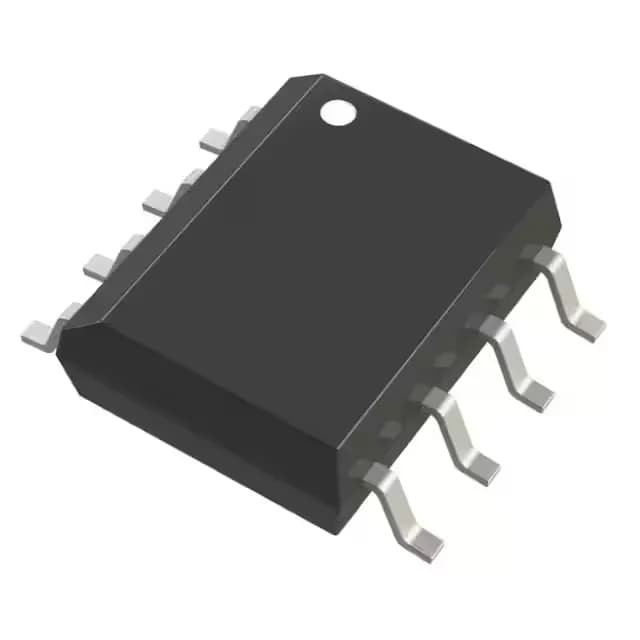
Dual op-amp with 350 kHz GBW and 35 µV offset — the low-power precision workhorse
It delivers a 350 kHz gain-bandwidth product and a 35 µV typical input offset voltage, drawing just 135 µA per amplifier from a supply spanning 2.7 V to 36 V.
The 350 kHz gain-bandwidth product sets the usable closed-loop bandwidth: at a gain of 10 you get roughly 35 kHz of flat response, enough for audio, low-frequency vibration monitoring, or control-loop compensation. The 0.11 V/µs slew rate means the output slews about 0.11 V per microsecond, so a 1 V peak-to-peak sine wave stays clean up to roughly 17.5 kHz — fine for DC-accurate filtering and slow ADC drivers, but not for fast pulse or video signals.
35 µV offset and 20 pA bias — precision without the trim pot
A 35 µV typical input offset voltage means you can amplify a 10 mV thermocouple signal by 100 and still see less than 0.35% offset error at the output — no external nulling required. The 20 pA input bias current keeps voltage drop across high-source-impedance resistors negligible; a 100 kΩ source sees only 2 µV of additional offset from bias current, which is well below the offset itself.
Each amplifier burns 135 µA, so the dual draws 270 µA total quiescent — low enough for always-on sensor nodes running from a single lithium cell (2.7 V min) or a 24 V industrial bus (36 V max). The 20 mA output current per channel can drive a reference input, a small relay coil, or a 600 Ω audio load. The wide supply span lets you reuse the same BOM across 3.3 V, 5 V, ±5 V, or 12 V systems without changing the op-amp.
It is not rated for automotive under-hood, outdoor telecom cabinets, or factory-floor applications where ambient may exceed 70°C. For extended industrial or automotive temperature ranges, look at the ADA4096-2WARMZ-RL which covers -40°C to 125°C.