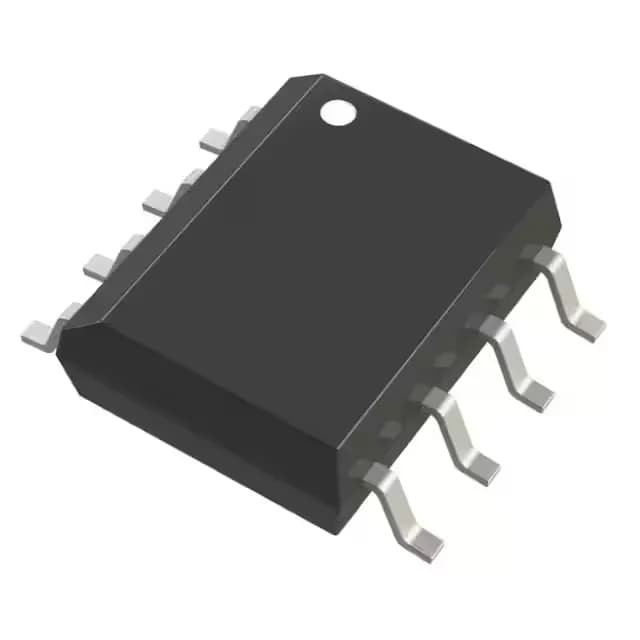
The LT1815CS8#PBF is a single-channel voltage-feedback op-amp from Linear Technology (now Analog Devices) built for high-speed signal conditioning. Its headline spec is a 1500 V/µs slew rate, paired with a 350 MHz -3 dB bandwidth and a 220 MHz gain-bandwidth product. That slew rate is roughly 15× faster than a typical 100 V/µs video amp, which means it can swing a 5 V peak-to-peak output in about 3.3 ns — fast enough to drive the input of a high-speed ADC, buffer a DAC reconstruction filter, or handle pulse signals in a laser diode driver without slew-induced distortion.
Supply range and single-supply flexibility
At 6.5 mA quiescent supply current, it is not a micropower part, but the power budget is reasonable for a 350 MHz amplifier. The 2 µA input bias current and 200 µV input offset voltage are typical for a bipolar-input high-speed stage — adequate for AC-coupled or moderate-precision DC paths, though not for precision instrumentation.
Package and temperature grade
This limits the part to indoor, controlled-environment equipment — office networking, bench test gear, or consumer video — not automotive under-hood or outdoor industrial enclosures.
Lifecycle and sourcing
It is ROHS3 compliant (the #PBF suffix confirms lead-free plating). The laser-etch date-code on the tube or reel should trace cleanly to the Analog Devices / Linear Tech plant — the #PBF suffix and consistent marking make relabeled gray-market stock easier to spot.
Second-source and comparison
The closest functional peer on the market is the AD8027ARZ from Analog Devices, also a single voltage-feedback amplifier in an 8-SOIC tube. The AD8027's 190 MHz -3 dB bandwidth is also roughly half the LT1815's 350 MHz. For a high-speed pulse or wideband application, the LT1815 is the faster choice; the AD8027 may suit a lower-speed, wider-temperature design where rail-to-rail output is needed. The two are not pin-compatible substitutes — the buyer should verify the board-level fit before swapping.