200 MHz GBW quad op-amp — what it buys you
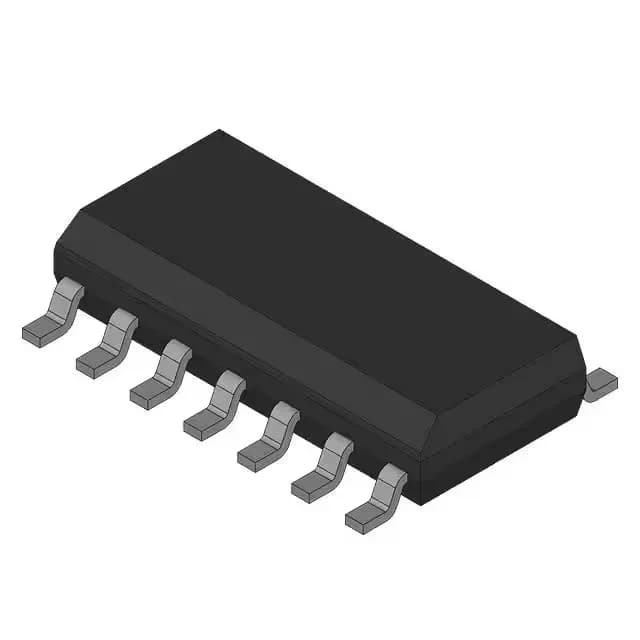
The LT1724IS#PBF is a quad general-purpose op-amp from the LT® series, packing four independent amplifiers in a 14-SOIC package. Its headline specs are a 200 MHz gain-bandwidth product and a 70 V/µs slew rate, which put it in the class of parts used for high-speed signal conditioning — think video distribution, IF amplifier chains, fast ADC drivers, or active filters where the passband extends into the tens of MHz. Each channel delivers 50 mA output current, enough to drive a 50 Ω or 75 Ω terminated line directly in many cases. Supply span runs from 5 V minimum to 10 V maximum, so it works off common ±5 V or single +5 V rails.
Slew rate and bandwidth — the speed decision
At 70 V/µs, the LT1724IS#PBF can swing a 5 Vpp output in about 70 ns without slew-rate limiting, which keeps distortion low for signals up to several MHz. The 200 MHz small-signal bandwidth means closed-loop gain stays flat well past 10 MHz for gains of 10 or less. Compare this to a part like the AD8624ACPZ-R7, which runs at 560 kHz GBW and 0.48 V/µs — that part is for low-frequency precision, not high-speed work. The AD8028ARMZ-REEL7 is closer at 190 MHz and 100 V/µs, but it is a dual, not a quad, so the LT1724IS#PBF saves board area when you need four channels.
Total supply current is 3.7 mA for all four amplifiers, or under 1 mA per channel. That is reasonable for a 200 MHz part — you are not paying a huge power penalty for the speed. Input offset voltage is 100 µV typical, and input bias current is 40 nA. These are not precision-instrumentation numbers (the AD8624ACPZ-R7 claims 10 µV offset and 45 pA bias), but they are fine for AC-coupled or moderate-gain DC applications where a few millivolts of offset do not matter. The 50 mA per-channel output current is a real advantage when driving cables or multiple loads.
Temperature range and package
Surface-mount assembly, no special thermal management needed at the 3.7 mA supply level.