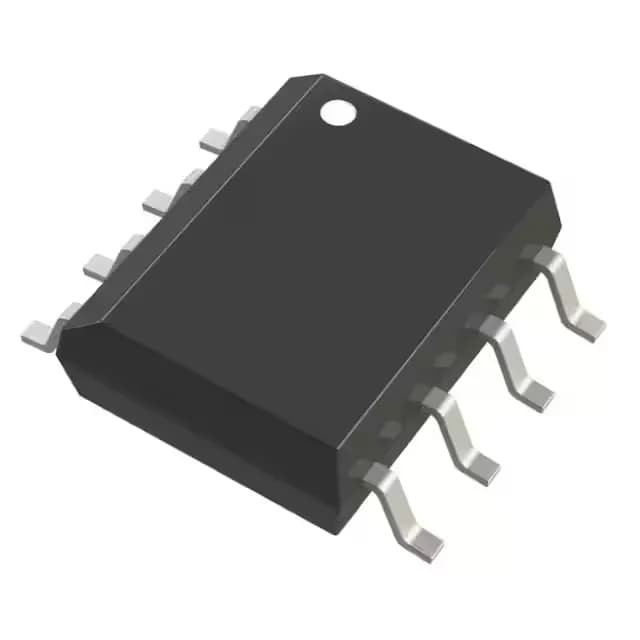
Its 1000V/µs slew rate means a 10 V output step settles in about 10 ns — fast enough for video line drivers, pulse amplifiers, and high-speed data acquisition front-ends where a conventional 70 MHz GBW op-amp would otherwise slew-limit at a few hundred kilohertz. The 70 MHz gain-bandwidth product covers the small-signal bandwidth, but the slew rate is the spec that decides whether the part can reproduce a full-swing waveform at high frequency without distortion. The C-Load™ designation means the output stage is compensated to remain stable with capacitive loads that would cause peaking or oscillation in a standard voltage-feedback amplifier. This is a practical advantage when driving long cables, ADC inputs with sampling capacitors, or multiplexer buses — the designer does not need to add a series isolation resistor and lose bandwidth.
The LT1363CS8#TRPBF operates from a single 5 V supply up to a 36 V total span (dual supplies up to ±18 V). The 60 mA output current per channel gives it enough drive for a 50 Ω back-terminated cable or a low-impedance load, though the thermal limit in the 8-SOIC package will constrain continuous dissipation at the higher supply voltages. Quiescent supply current is 6.3 mA, which is moderate for this speed class — the AD8007 current-feedback alternative draws 9 mA, while the ADA4817 draws 19 mA.
Package and temperature grade — fit for commercial equipment
The supplier device package is 8-SO. For industrial or automotive applications requiring -40°C operation, the ADA4817-1ARDZ-R7 covers that range.