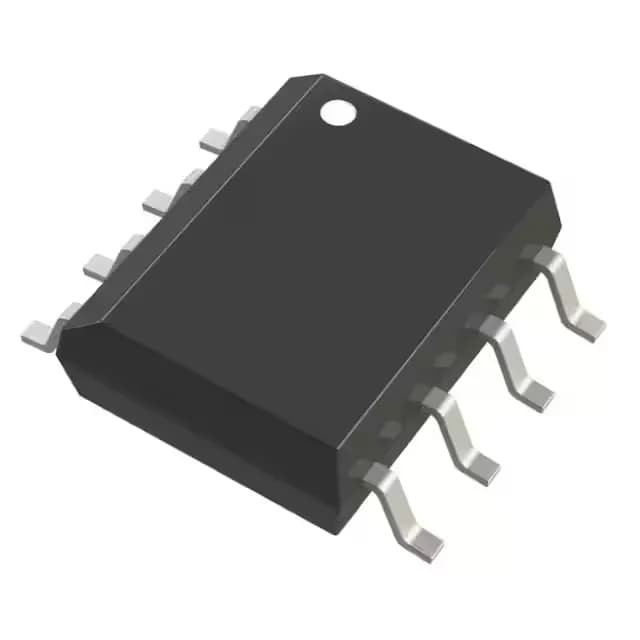
Differential amplifier for balanced-line signal conditioning
The LT1187CS8#PBF: It targets balanced-line receivers, video distribution amplifiers, and instrumentation front-ends where the signal is carried on a twisted pair or coax and needs clean recovery at the receiving end. The supply range spans 4.75 V to 16 V for single-supply operation, or ±2.38 V to ±8 V when using split rails. Each package contains one differential amplifier circuit, drawing a quiescent supply current of 13 mA and capable of delivering 20 mA per channel output drive.
The 165 V/µs slew rate determines how fast the output can swing under large-signal conditions — think step responses from digital video signals or fast pulse edges from sensors. For a differential receiver driving a 2 V peak-to-peak signal, this slew rate supports rise times under 15 ns, adequate for composite video (NTSC/PAL) or high-speed data links up to several megabits per second over twisted-pair cable. When paired with the 50 MHz -3 dB bandwidth, the amplifier can handle signals up to roughly 5 MHz with full output swing before slew-rate limiting sets in. For smaller signals, the bandwidth extends to the full 50 MHz, so low-level high-frequency content passes cleanly.
Active lifecycle — no redesign pressure
For a BOM line, this removes the short-term redesign risk that comes with NRND or obsolete parts. The ROHS3 compliance ensures it meets current environmental requirements for European and global markets.
Single 5 V supply compatibility
Yes, the LT1187CS8#PBF operates from a single 5 V supply — the minimum single-supply voltage is 4.75 V, which covers the nominal 5 V rail with margin for ripple and tolerance. In a single 5 V configuration, the input and output common-mode ranges must stay within the supply rails; the part is specified for differential operation, so the input signal is the difference between two inputs, both referenced to ground. For 5 V-only designs, verify the input common-mode range against the signal source.