5A switch, 60V input — the load and bus envelope
The LT1170HVCT#PBF is a monolithic switching regulator from Analog Devices that integrates a 5A switch on-chip, rated for input voltages from 3V up to 60V and a switch voltage of 75V. It operates as a step-up, step-down, or step-up/step-down converter across five topologies: buck, boost, Cuk, flyback, and forward converter — one part covers isolated and non-isolated designs up to 5A.
100 kHz fixed-frequency switching and adjustable output
The switching frequency is fixed at 100 kHz, which sets the inductor and transformer sizing — for a given ripple current, a lower frequency means larger magnetics but lower switching losses in the 5A switch. Output voltage is adjustable from a 1.244V reference up to 75V (limited by the switch rating), with positive or negative output configuration, so it serves rails from logic supplies to high-voltage bias lines. No synchronous rectifier is integrated — the external diode handles the catch current, which is a design consideration for efficiency at low output voltages where the diode forward drop dominates conduction loss.
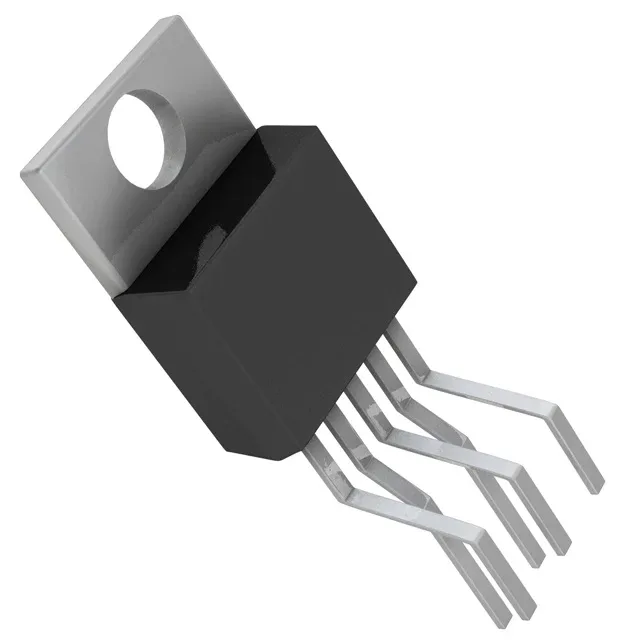
TO-220-5 through-hole package and thermal path
The TO-220-5 package (supplier device package TO-220-5) provides a metal tab for heatsinking — the tab is the switch node, so the heatsink must be electrically isolated or the system ground must tolerate the switching waveform. Through-hole mounting suits bench prototypes, evaluation boards, and production where the PCB can handle the lead pitch and the heatsink is bolted to the chassis or a dedicated heatsink.
Operating junction temperature range is 0°C to 100°C, which covers most commercial and industrial environments but not extended-temperature or automotive applications.