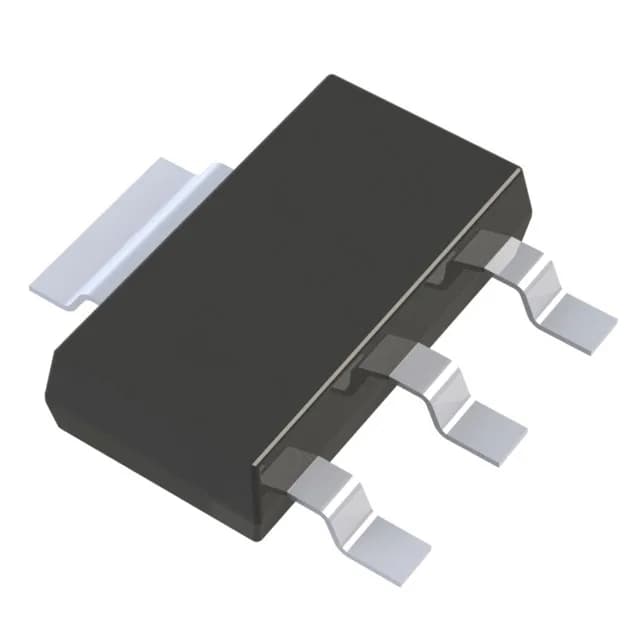
Package and mounting
The LT1117IST-5#TRPBF is a Linear Technology fixed 5 V output positive LDO regulator rated for 800 mA continuous output current. The 75 dB PSRR at 120 Hz tells you this part is tuned for cleaning up rectified mains ripple — think post-bridge-rectifier rails in a 50/60 Hz supply, not a switching regulator's MHz hash. The maximum dropout voltage of 1.3 V at 800 mA means you need at least 6.3 V on the input to hold regulation at full load; at lighter loads the dropout is lower, but the 1.3 V ceiling is the number to budget for in worst-case line sag.
SOT-223-3 — hand-solderable, no hot-air station required
The SOT-223-3 package is a rework-friendly footprint. Three visible pins plus a large tab on the bottom — the tab is the output (Vout) and also the main thermal path. On a site visit with just a temperature-controlled iron and some flux, you can swap this part in under a minute. No hot-air station, no preheater. Just tack the tab first, then the pins. The tab is the same node as pin 2 (output), so if you accidentally short the tab to the ground plane you have a dead short — keep the copper pour under the tab connected to Vout, not ground. The package is rated for surface-mount reflow, but for a field repair the iron method works fine as long as you pre-tin the pad and the tab.
Dropout and quiescent — sizing the input rail and the battery budget
Maximum dropout is 1.3 V at 800 mA output. That means a 5 V rail needs at least 6.3 V input to stay in regulation at full load. If your input is a 12 V bus, that is fine — you have plenty of headroom. If you are running from a 6 V battery that sags to 5.8 V under load, this part will drop out and the output will follow the input minus the dropout voltage. The quiescent current is 10 mA — not a micropower part. For a battery-powered sensor node that sleeps most of the time, the 10 mA Iq will drain the cell faster than a low-Iq LDO. This part is better suited to always-on rails in line-powered equipment where the 10 mA is negligible.
The ROHS3 compliance means the solder finish is lead-free per the latest EU directive — no exemption paperwork, no special handling for export.