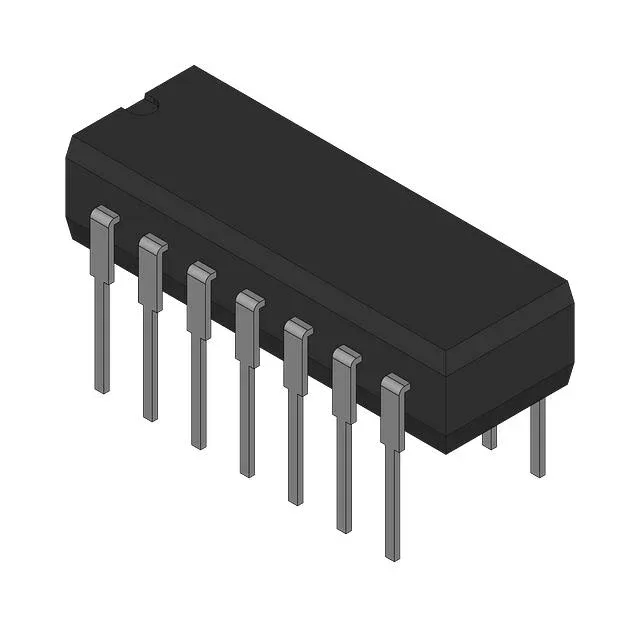
What this quad CMOS op-amp brings to a high-impedance signal chain
The Intersil ICL7642EMJD is a CMOS quad operational amplifier in a hermetic 14-CDIP package, built for environments where temperature swings and signal integrity matter more than board area. Each of its four amplifiers delivers a 1.4 MHz gain-bandwidth product and a 1.6V/µs slew rate — enough for audio-frequency conditioning, control-loop compensation, or buffering precision references. The CMOS front end keeps input bias current at 1 pA, a spec that matters when the source impedance runs into the megaohm range: photodiode transimpedance stages, pH probe buffers, or electrometer-grade integrators. Rail-to-rail output swing extends the usable dynamic range in single-supply designs running from 2 V up to 16 V.
Temperature range and package — why the hermetic CDIP matters
The 14-CDIP (0.300", 7.62mm) ceramic package is hermetic, so moisture ingress and outgassing are non-issues in vacuum, high-altitude, or sealed-module environments. Through-hole mounting makes it straightforward to hand-assemble or rework in a prototype run, and the ceramic body handles repeated soldering thermal cycles better than plastic DIP. For a board destined for avionics, satellite payload, or downhole instrumentation, this package choice alone can justify the BOM line.
Supply current and offset — the trade-offs at a glance
Each amplifier draws 1 mA of supply current, so the full quad sinks 4 mA quiescent — low enough for battery-powered remote sensors, but not micropower. The 20 mV maximum input offset voltage is a reminder this is a general-purpose CMOS op-amp, not a precision part; if the design requires microvolt-level DC accuracy, plan for external offset nulling or select a trimmed variant. The 2 V to 16 V supply span gives flexibility: a single lithium cell (3.6 V nominal) or a split ±5 V rail both work, as long as the common-mode input range is respected.
Note that the device is RoHS non-compliant (lead-bearing solder finish on the CDIP leads), which may restrict use in jurisdictions with full RoHS exemptions for high-reliability / military equipment. If your production line is RoHS-only, plan for a segregated hand-solder or a waiver review.