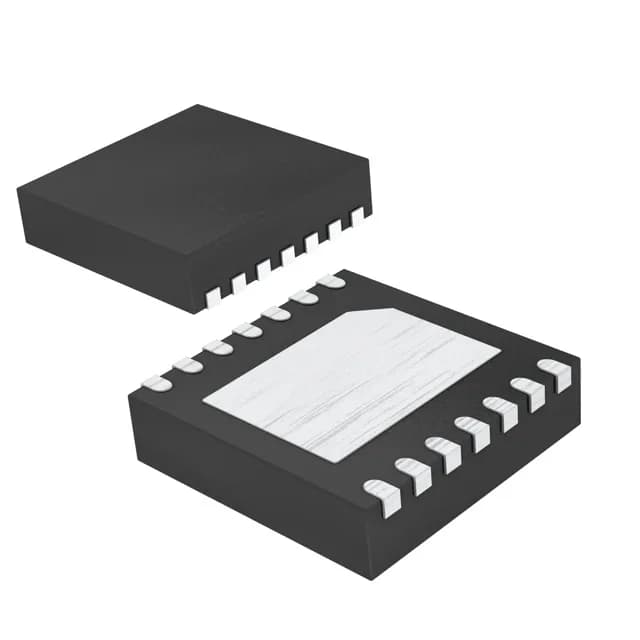
What this part is — a 7-bit current-output DAC with I²C control
The Maxim DS4424N+ is a 7-bit digital-to-analog converter that delivers a current output — not a voltage — configured as either a current sink or current source depending on the load side. It packs four independent DACs into a single 14-TDFN (3x3 mm) package, controlled over an I²C bus. The architecture is built for trimming or margining power supplies, biasing laser diodes, or setting current levels in industrial transmitters where a voltage-output DAC would need an extra op-amp stage. Each channel sinks or sources current directly, so the output is unbuffered — the load sees the DAC's own output impedance. That matters when the load impedance varies: the current accuracy holds as long as the compliance voltage stays within the supply rails. The I²C interface handles all four channels on a single bus address, with the data word setting the output current magnitude.
Key ratings and what they mean for the BOM
Integral nonlinearity is ±1 LSB maximum, differential nonlinearity ±0.5 LSB maximum — monotonicity is guaranteed, so the output never reverses direction as the code increments. That is the spec that matters when the DAC is in a closed-loop control path: a non-monotonic step can cause oscillation.
Where it fits — typical applications and environments
This class of current-output DAC is common in power-supply margining (adjusting a DC-DC converter's feedback node up or down during test), laser-diode bias control in fiber-optic transceivers, and programmable current-loop transmitters. The I²C interface makes it a natural fit for systems that already have an I²C bus — microcontrollers, FPGAs, or dedicated PMBus controllers. The 14-TDFN package is small enough for space-constrained designs like SFP modules or compact sensor heads.
Sourcing and lifecycle — active, no LTB risk
The DS4424N+ carries an active lifecycle status from Maxim (now part of Analog Devices). ROHS3 compliant, so it passes the current EU material-restriction requirements without an exemption.