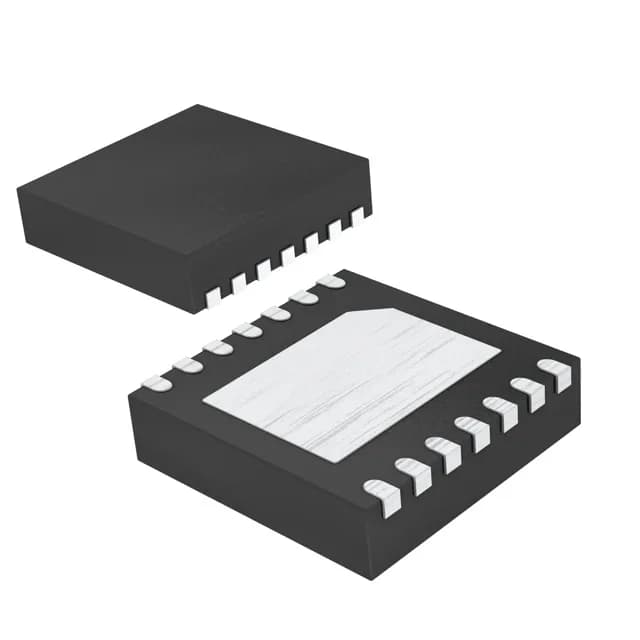
What the DS4404N+ is and where it fits
The Maxim DS4404N+ is a 5-bit, 4-channel current-output DAC that can sink or source current — each channel independently programmed via an I²C interface. The 5-bit resolution makes it a trim DAC; its ±1 LSB max INL and ±0.5 LSB max DNL guarantee monotonicity across codes. The analog and digital supplies share a single 2.7 V to 5.5 V rail. Typical applications include bias/offset adjustment in power-supply margining, laser-diode current control, and VCO tuning in PLLs — anywhere a small, digitally programmable current is needed. The -40°C to +85°C operating range suits industrial equipment, base-station transceivers, and outdoor telecom line cards.
Current-sink/source architecture — what it means for the loop
Unlike a voltage-output DAC followed by an external V-to-I converter, the DS4404N+ directly drives current into or out of a node. The current-sink mode pulls current to ground; current-source mode pushes current from the supply. The output is unbuffered, so the load impedance and compliance voltage matter — the DAC can only swing its output within the supply rails minus a dropout. Each of the four DACs is independent, but all share the same I²C bus address. The 5-bit word sets the output current magnitude; the sink/source direction is also programmable per channel. This architecture is common in power-supply margining where you need to nudge a feedback node up or down by a few percent.
Package and board-level fit
The 14-TDFN (3x3 mm) package is a small, leadless DFN with an exposed pad. The pad must be soldered to a PCB thermal land and, ideally, connected to a ground plane for heat spreading. The part is surface-mount only; no through-hole option exists. Tube shipment means the parts arrive in a plastic tube, not tape-and-reel — if your pick-and-place feeder expects reels, plan to transfer to a carrier tape or hand-place for prototypes.
Lifecycle and compliance
It is ROHS3 compliant, so it meets the EU RoHS exemption-free standard — no lead, mercury, cadmium, or restricted phthalates. No AEC-Q100 qualification is listed, so it is not formally rated for automotive-grade use.